Quotessence
Home / Quotes / Quote by Gerald Edelman

Quote by Gerald Edelman

“Consciousness may be seen as the haughty and restless second cousin of morphology. Memory is its mistress, perception its somewhat abused wife, logic its housekeeper, and language its poorly paid secretary”

Quote by Gerald Edelman

Author
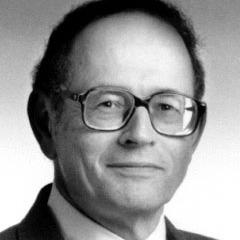
Gerald Edelman
Gerald Edelman

Gerald Edelman was a prominent neuroscientist and immunologist whose research focused on the interaction between the immune system and the brain. His work delved into how the immune system recognizes and attacks foreign substances, and how this process relates to the functioning of the brain. Edelman's research has significant implications for understanding autoimmune diseases and neurodegenerative disorders. more

You May Also Like

“[O]ur percept is an elaborate computer model in the brain, constructed on the basis of information coming from [the environment], but transformed in the head into a form in which that information can be used. Wavelength differences in the light out there become coded as 'colour' differences in the computer model in the head. Shape and other attributes are encoded in the same kind of way, encoded into a form that is convenient to handle. The sensation of seeing is, for us, very different from the sensation of hearing, but this cannot be directly due to the physical differences between light and sound. Both light and sound are, after all, translated by the respective sense organs into the same kind of nerve impulses. It is impossible to tell, from the physical attributes of a nerve impulse, whether it is conveying information about light, about sound or about smell. The reason the sensation of seeing is so different from the sensation of hearing and the sensation of smelling is that the brain finds it convenient to use different kinds of internal model of the visual world, the world of sound and the world of smell. It is because we internally use our visual information and our sound information in different ways and for different purposes that the sensations of seeing and hearing are so different. It is not directly because of the physical differences between light and sound.”

“Children discover and verify their theories in quite the same way that scientists do: through experimentation. They manipulate the world and discover regularities of causation from those manipulations. Why do they do it? The discovery of regularities comes with a pleasurable burst of insight, which all of us, but especially children and scientists, continuously long for like bonbons or opium.”

“[T]he form that an animal's subjective experience takes will be a property of the internal computer model. That model will be designed, in evolution, for its suitability for useful internal representation, irrespective of the physical stimuli that come to it from outside. Bats and we need the same kind of internal model for representing the position of objects in three-dimensional space. The fact that bats construct their internal model with the aid of echoes, while we construct ours with the aid of light, is irrelevant.”

“Truly to realize the ambitions of a science of mind does not solely involve learning about such issues as how we know, perceive and solve problems; it involves finding out tow hat extent the world outside us is knowable by us, and indeed prescribing the limits of inquiry for disciplines like Physics which claim to afford knowledge of the external physical world.”

“Once we have isolated the computational and neurological correlates of access-consciousness, there is nothing left to explain. It's just irrational to insist that sentience remains unexplained after all the manifestations of sentience have been accounted for, just because the computations don't have anything sentient in them. It's like insisting that wetness remains unexplained even after all the manifestations of wetness have been accounted for, because moving molecules aren't wet.”

“A synthesis—an abstraction, chunk, or gist idea—is a neural pattern. Good chunks form neural patterns that resonate, not only within the subject we’re working in, but with other subjects and areas of our lives. The abstraction helps you transfer ideas from one area to another. That’s why great art, poetry, music, and literature can be so compelling. When we grasp the chunk, it takes on a new life in our own minds—we form ideas that enhance and enlighten the neural patterns we already possess, allowing us to more readily see and develop other related patterns. Once we have created a chunk as a neural pattern, we can more easily pass that chunked pattern to others, as Cajal and other great artists, poets, scientists, and writers have done for millennia, Once other people grasp that chunk, not only can they use it, but also they can more easily create similar chunks that apply to other areas in their lives—an important part of the creative process.”