Quotessence
Home / Quotes / Quote by Karl Marx

Quote by Karl Marx

“You are horrified at our intending to do away with private property. But in your existing society private property is already done away with for nine-tenths of the population; its existence for the few is solely due to its non-existence in the hands of those nine-tenths. You reproach us, therefore, with intending to do away with a form of property, the necessary condition for whose existence is the non-existence of any property for the immense majority of society. In one word, you reproach us with intending to do away with your property. Precisely so: that is just what we intend.”

Quote by Karl Marx

Work

The Communist Manifesto

Written by Karl Marx and Friedrich Engels, this influential work analyzes the historical development of capitalism and advocates for the establishment of a classless society through the proletariat's revolution. more

Author
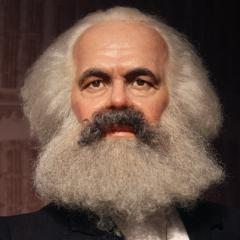
Karl Marx
Karl Marx

Karl Marx (May 5, 1818 - March 14, 1883) was a German philosopher, economist, sociologist, political theorist, and revolutionary. He is one of the founders of Marxism and his works, including 'Das Kapital' and 'The Communist Manifesto', have had a profound impact on the world. more

You May Also Like

“They say, 'No private property', and immediately after strive to maintain private property in its daily manifestations. 'You shall be a commune as far as regards production: fields, tools, machinery, all that has been invented up till now - factories, railways, harbours, mines, etc., all are yours. Not the slightest distinction will be made concerning the share of each in this collective property. 'But from tomorrow you will minutely debate the share you are going to take in the creation of new machinery, in the digging of new mines. You will carefully weigh what part of the new produce belongs to you. You will count your minutes of work, and you will take care that a minute of your neighbours should not buy more than yours. 'And as an hour measures nothing, as in some factories a worker can see to six power-looms at a time, while in another he only tends two, you will weigh the muscular force, the brain energy, and the nervous energy you have expended. You will accurately calculate the years of apprenticeship in order to appraise the amount each will contribute to future production. And this - after having declared that you do not take into account his share in past production.' Well, for us it is evident that a society cannot be based on two absolutely opposed principles, two principles that contradict one another continually. And a nation or a commune which would have such an organization would be compelled to revert to private property in the instruments of production, or to transform itself into a communist society.”

“In principle the human productive community may be constituted in either of two ways. First, it may be consciously regulated. Whether its scale is that of a self-sufficient patriarchal family, a communistic tribe, or a socialist society, it creates the organs which, acting as the agents of social consciousness, fix the extent and methods of production and distribute the social product thus obtained among the members. Given the material and man-made conditions of production, all decisions as to method, place, quantity and available tools involved in the production of new goods are made by the /pater familias, /or by the local regional or national commissars of the socialist society. The personal experience of the former gives him a knowledge of the needs and productive resources of his family; the latter can acquire a like knowledge of the requirements of their society by means of comprehensively organized statistics of production and consumption. They can thus shape, with conscious foresight, the whole economic life of the communities of which they are the appointed representatives and leaders in accordance with the needs of the members. The individual members of such a community consciously regulate their productive activity as members of a productive community. Their labour process and the distribution of their products are subject to central control. Their relations of production are directly manifest as social relations, and the economic relations between individuals can be seen as being determined by the social order, by social arrangements rather than by private inclination. Relations of production are accepted as those which are established and desired by the whole community. Matters are different in a society which lacks this conscious organization. Such a society is dissolved into a large number of mutually independent individuals for whom production is a private matter rather than a social concern. In other words, its members are individual proprietors who are compelled by the development of the division of labour to do business with one another. The act by which this is accomplished is the exchange of commodities. It is only this act which establishes connections in a society otherwise dismembered into disparate units by private property and the division of labour. Exchange is the subject matter of theoretical economics only because, and to the extent that, it performs this mediating function in the social structure. It is of course true that exchange may also take place in a socialist society, but that would be a type of exchange occurring only after the product had already been distributed according to a socially desired norm. It would therefore be merely an individual adaptation of the distributive norm of society, a personal transaction influenced by subjective moods and considerations. It would not be an object for economic analysis. It would have no more importance for theoretical analysis than does the exchange of toys between two children in the nursery, an exchange which is fundamentally different in character from the purchases made by their fathers at the toy shop. For the latter is only one element in the sum of exchanges by which society realizes itself as the productive community which it really is. A productive community must express itself in such acts of exchange because only in this way can the unity of society, dissolved by private property and the division of labour, be restored.”

“That the Open Society cannot exist without extensive individual property rights that clearly identify endowments and freedom to employ them does not imply that all resources, much less all decision-making, is to be privatized. Whether privatization is the best way to make resource decisions depends on the nature of the resources and the moral norms of a population. Consequently, it is mistake to claim that the Open Society requires 'full liberal ownership rights' over the maximally large range of resources. This merits emphasis: that robust individual property rights are required for the Open Society does not entail that expanding the sphere of private property is always friendly to the Open Society.”

“Indeed there is a strong general cases, founded on the legitimacy of a considerable degree of egoism and self-referential altruism, and connected with what I have offered as the basic case for rights as the essential device for securing areas for the free pursuit of happiness, in favour of some private property. This is one point among many where our grounds for dissatisfaction with at least the cruder forms of utilitarianism have practical consequences. If we see the good for man as happiness, conceived as a single, undifferentiated commodity, we may also suppose that it could be provided for all, in some centrally planned way, if only we could get an authority that was sufficiently powerful and sufficiently intelligent, and also one that we could trust to be uniformly well-disposed to all its subjects; and then the natural corollary would be that all property should be owned by all in common, collectively, and applied to the maximizing of the genral happiness under the direction of this benevolent authority. But if we reject this unitary notion of happiness, and identify the good for man rather with the partly competitive pursuit of diverse ideals and private goals, then separate ownership of property will be an appropriate instrument for this pursuit.”

“You are horrified at our intending to do away with private property.  But in your existing society, private property is already done away with for nine-tenths of the population; its existence for the few is solely due to its non-existence in the hands of those nine-tenths.  You reproach us, therefore, with intending to do away with a form of property, the necessary condition for whose existence is the non-existence of any property for the immense majority of society. In a word, you reproach us with intending to do away with your property. Precisely so, that is just what we intend.”

“The form of family corresponding to civilization and coming to definite supremacy with it is monogamy, the domination of the man over the woman, and the single family as the economic unit of society. The central link in civilized society is the state, which in all typical periods is without exception the state of the ruling class, and in all cases continues to be essentially a machine for holding down the oppressed, exploited class.”