Quotessence
Home / Quotes / Quote by Karl Marx

Quote by Karl Marx

“You are horrified at our intending to do away with private property.  But in your existing society, private property is already done away with for nine-tenths of the population; its existence for the few is solely due to its non-existence in the hands of those nine-tenths.  You reproach us, therefore, with intending to do away with a form of property, the necessary condition for whose existence is the non-existence of any property for the immense majority of society. In a word, you reproach us with intending to do away with your property. Precisely so, that is just what we intend.”

Quote by Karl Marx

Work

The Communist Manifesto

Written by Karl Marx and Friedrich Engels, this influential work analyzes the historical development of capitalism and advocates for the establishment of a classless society through the proletariat's revolution. more

Author
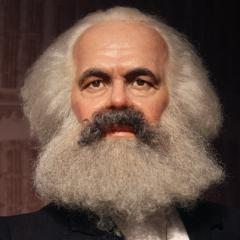
Karl Marx
Karl Marx

Karl Marx (May 5, 1818 - March 14, 1883) was a German philosopher, economist, sociologist, political theorist, and revolutionary. He is one of the founders of Marxism and his works, including 'Das Kapital' and 'The Communist Manifesto', have had a profound impact on the world. more

You May Also Like

“The form of family corresponding to civilization and coming to definite supremacy with it is monogamy, the domination of the man over the woman, and the single family as the economic unit of society. The central link in civilized society is the state, which in all typical periods is without exception the state of the ruling class, and in all cases continues to be essentially a machine for holding down the oppressed, exploited class.”

“The purchaser draws boundaries, fences himself in, and says, “This is mine; each one by himself, each one for himself.” Here, then, is a piece of land upon which, henceforth, no one has a right to step, save the proprietor and his friends; which can benefit nobody, save the proprietor and his servants. Let these sales multiply, and soon the people — who have been neither able nor willing to sell, and who have received none of the proceeds of the sale — will have nowhere to rest, no place of shelter, no ground to till. They will die of hunger at the proprietor’s door, on the edge of that property which was their birthright; and the proprietor, watching them die, will exclaim, “So perish idlers and vagrants!”

“John Locke, called the Father of Liberalism, made the argument that the individual instead of the community was the foundation of society. He believed that government existed by the consent of the governed, not by divine right. But the reason government is necessary is to defend private property, to keep people from stealing from each other. This idea appealed to the wealthy for an obvious reason: they wanted to keep their wealth. From the perspective of the poor, things look decidedly different. The rich are able to accumulate wealth by taking the labor of the poor and by turning the commons into privately owned commodities; therefore, defending the accumulation of wealth in a system that has no other moral constraints is in effect defending theft, not protecting against it.”

“I can quite understand a man accepting laws that protect private property, and admit of its accumulation, as long as he himself is able under those conditions to realise some form of beautiful and intellectual life. But it is almost incredible to me how a man whose life is marred and made hideous by such laws can possibly acquiesce in their continuance.”

“[T]he power of enclosing land and owning property was brought into the creation by your ancestors by the sword; which first did murder their fellow creatures, men, and after plunder or steal away their land, and left this land successively to you, their children. And therefore, though you did not kill or thieve, yet you hold that cursed thing in your hand by the power of the sword; and so you justify the wicked deeds of your fathers, and that sin of your father shall be visited upon the head of you and your children to the third and fourth generation, and longer too, till your bloody and thieving power be rooted out of the land.”

“It is also interesting to observe that communal ownership violates every instinct of human nature. It destroys initiative, nullifies free agency, suppresses inventive exploration, minimizes the dignity of the individual and makes a god out of an abstract thing called "The State"- to which is delegated complete, unrestricted control over life, liberty and property. . . Like so many other weak systems of government, it can survive only in an atmosphere of a slave state, ruled by a king or a dictator.”

“Boredom has a bad reputation. In a world of constant entertainment, the slightest lull sends us to our phones. Yet boredom can be a doorway. When we are bored, our minds begin to wander. Without external input, we may turn inward. Ideas bubble up. Connections form. Boredom is the soil from which creativity often grows.”

“The vulgar Marxist concept of 'private enterprise' was totally misconstrued by man's irrationality; it was understood to mean that the liberal development of society precluded every private possession. Naturally, this was widely exploited by political reaction. Quite obviously, social development and individual freedom have nothing to do with the so-called abolishment of private property. Marx's concept of private property did not refer to man's shirts, pants, typewriters, toilet paper, books, beds, savings, houses, real estate, etc. This concept was used exclusively in reference to the private ownership of the social means of production, i.e., those means of production that determine the general course of society. In other words: railroads, waterworks, generating plants, coal mines, etc. The 'socialization of the means of production' became such a bugbear precisely because it was confounded to mean the 'private exploitation' of chickens, shirts, books, residences, etc., in conformity with the ideology of the expropriated.”

“The notion that property is the means to all other means was ruled out by the new radicals. The deep seated ressentiment towards private property, indeed towards anything private, blocked the conclusion that follows from any impartial examination of wealth-producing and freedom-favouring mechanisms: an effective world improvement would call for the most general possible propertization. Instead, the political metanoeticians enthused over general dispossession, akin to the founders of Christian orders who wanted to own everything communally and nothing individually. The most important insight into the dynamics of economic modernization remained inaccessible to them: money created by lending on property is the universal means of world improvement. They are all the blinder to the fact that for the meantime, only the modern tax state, the anonymous hyper-billionaire, can act as a general world-improver, naturally in alliance with the local meliorists - not only because of its traditional school power, but most of all thanks to its redistributive power, which took on unbelievable proportions in the course of the twentieth century. The current tax state, for its part, can only survive as long as it is based on a property economy whose actors put up no resistance when half of their total product is taken away, year after year, by the very visible hand of the national treasury for the sake of communal tasks. What the un-calm understands least of all is the simple fact that when government expenditures constitute almost 50 per cent of the gross national product, this fulfills the requirements of actually existing liberal-fiscal semi-socialism, regardless of what label is used to describe this situation - whether people call it the New Deal, 'social market economy' or 'neoliberalism'. What the system lacks for total perfection is a homogeneous worldwide tax sphere and the long-overdue propertization of the impoverished world.”