Quotessence
Home / Quotes / Quote by Patricia C. Wrede

Quote by Patricia C. Wrede

“(In reply to the question, 'Would you like some suggestions for a plot for your next book?') There are three problems with getting plot suggestions from other people. The first is that ideas are the easy part of writing; finding the time and energy to get them down on paper is the hard part. I have plenty of ideas already. Which brings me to the second problem: the ideas that excite you, the ones you think would make a terrific book, are not necessarily the same ideas that excite me. And if a writer isn't excited about an idea, she generally doesn't turn out a terrific book, even if the idea is terrific. And the third problem with my using your suggestions is that, theoretically, you could sue me if I did, and that tends to make publishers nervous, which makes it hard to sell a book. So thank you, but no.”

Quote by Patricia C. Wrede

Author
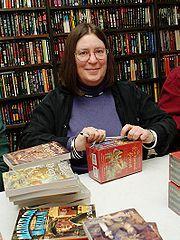
Patricia C. Wrede
Patricia C. Wrede

Patricia C. Wrede (born March 27, 1953) is an acclaimed American fantasy author, best known for the Enchanted Forest Chronicles and the Lyra series. Her works are celebrated for their humor, wit, and subversion of traditional fantasy tropes, appealing to both young adult and adult readers. Born in Chicago, Illinois, she earned a biology degree from Carleton College before turning to writing. Wrede served as president of the Science Fiction and Fantasy Writers of America (SFWA) and has been nominated for multiple Nebula and Hugo Awards. Her innovative storytelling has left a lasting mark on the fantasy genre. more

You May Also Like

“Don't let your husband feel you are a 'dear little woman' but no good intellectually. If you find yourself getting stale, wake up your brain. Let there be nothing your husband can talk about that you will be unable to understand. Don't profess to know nothing about politics. Any man who is worth his salt does care, and many men learn to despise women as a whole because their wives take such an unintelligent attitude.”

“This book appears at a time when public discussion of the common atrocities of sexual and domestic life has been made possible by the women’s movement, and when public discussion of the common atrocities of political life has been made possible by the movement for human rights. I expect the book to be controversial—first, because it is written from a feminist perspective; second, because it challenges established diagnostic concepts; but third and perhaps most importantly, because it speaks about horrible things, things that no one really wants to hear about.”

“Sometimes, love isn’t about grand gestures or fiery passion—it’s about quiet understanding, small moments, and the choice to stay. As Sabi stands on her balcony, the morning sun warming her skin, she reflects on the changes since that fateful night. The air carries the scent of jasmine, a contrast to the storm that once raged within her. There were no dramatic confrontations, only space—to heal, to see what had always been there. The silence, once heavy, now feels comforting. In Sujit’s quiet gestures—his careful preparation of her tea, the soft shawl draped over her shoulders, the way he listens without expectation—Sabi notices the tenderness she once overlooked. Watching him tend to his roses below, she realizes he doesn’t need to look up; he knows she’s there. That quiet certainty settles something deep within her. She had once been drawn to passion’s intensity, mistaking fire for love. But flames consume, leaving only ashes. Sujit’s presence, steady and unspoken, teaches her love isn’t about burning bright—it’s about enduring warmth. It’s a love that doesn’t demand but offers, a love that whispers, I see you, and I am here.”

“Sitting with Ricki [Abrams], talking with Ricki, I made a vow to her: that I would use everything I knew, including from prostitution, to make the women`s movement stronger and better; that I`d give my life to the movement and for the movement. I promised to honour-bound to the well-being of women, to do anything necessary for that well-being. I promised to live and to die if need be for women. I made that vow some thirty years ago, and I have not betrayed it yet.”

“The suffragettes were easy to condemn, but hard to ignore. Their actions also boosted donations to peaceful, law-abiding suffragist societies. Many of those who claimed to be repelled by the militants were what we would now call "concern trolls" pretending to care about the success of a movement they never supported anyway.”