Quotessence
Home / Quotes / Quote by Milan Kundera

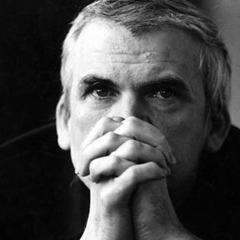
Quote by Milan Kundera

“The uniform is that which we do not choose, that which is assigned to us; it is the certitude of the universal against the precariousness of the individual. When the values that were once so solid come under challenge and withdraw, heads bowed, he who cannot live without them (without fidelity, family, country, discipline, without love) buttons himself up in the universality of his uniform as if that uniform were the last shred of transcendence that could protect him against the cold of a future in which there will be nothing left to respect.”

Quote by Milan Kundera

Work

The Art of the Novel

Browse quotes and source details for this work. more

Author

Milan Kundera
Milan Kundera

Milan Kundera is a renowned Czech-French writer known for his profound psychological insights and unique narrative techniques. His works often explore themes of personal freedom, love, morality, and existentialism, with notable titles including 'The Unbearable Lightness of Being' and 'The Joke'. more

You May Also Like

“As the conference continued it occurred to me finally that it wasn't really about Indian history as it was written, but really about rewriting it by taking a fresh look at race, ethnicity, gender, and a mix of sociocultural questions... I just couldn't believe how far along the desi scene was, not just socially but intellectually, how many people were out there thinking about it. This whole event so far rocked my world, muddled me still more, and delivered a series of tiny epiphanies, all at the same time. To be honest, I was quite intimidated by the dialogue going on, as well as by the passion and conviction of these people on so many subjects which I, frankly, had never really even thought about. ...A history of a people in transit -- what could that be card catalogued under? And the history of the ABCD. Everyone seemed to know about this ABCD thing -- that didn't seem very confused to me! And it was a relatively new phenomenon; it had never occurred to me that things going on now could have a history already. The moments that made up my life in the present tense seemed so fleetingly urgent and self-contained to me: I'd always felt my life had very little to do with my parents' and especially their parents' histories...and that it would have very little effect on anything to come. But the way these people were talking -- about desis in Hollywood; South Asian Studies departments; the relatively new Asian Indian slot on the census -- was hummingly sculpting the air, as if they were making history as they spoke. Making it, messily but surely, even simply by speaking. I was feeling it, too -- a sense of history in the making. But where did I fit in to any of it? And how come no one had told me?”

“American Born Confused Desi Emigrated From Gujarat House In Jersey Keeping Lotsa Motels Named Omkarnath Patel Quickly Reaching Success Through Underhanded Vicious Ways Xenophobic Yet Zestful. or American Born Confused Desi Emigrated from Gujarat House In Jersey Kids Learning Medicine Now Owning Property Quite Reasonable Salary Two Uncles Visiting White Xenophobia Yet Zestful Now you know your ABCDs.”

“You see,' Gwyn said slowly...'With an Indian boy maybe you can, you know, explore all that stuff. Go kamasutronic, so to speak.' I nodded, but I was feeling battle fatigue and was now thinking the tip of another thought: Or maybe an Indian boy would get that most of us don't know that stuff. That it was a lot of hype. It was the bindi blondes who were all over this scene, not the holelessly nosed Indian girls.”

“I knew they were my people, but it didn't feel like it. I was pushing against any first-generation narrative, while all the people in that area were seemingly proud of it. Aunties wore salwars to go grocery shopping, and little kids had those silver or gold bangles we were all given at birth...We were different from them, and I was determined to keep us different. Every piece of gold jewelry ever given to me was hidden in my dresser; I refused to wear any of it, because it made me feel I was being marked as an Other. (I now wear all of it, sometimes at the same time, a signal to other Others that I'm an Other too.)”

“Space, like time, gives birth to forgetfulness, but does so by removing an individual from all relationships and placing him in a free and pristine state--indeed, in but a moment it can turn a pedant and philistine into something like a vagabond. Time, they say, is water from the river Lethe, but alien air is a similar drink; and if its effects are less profound, it works all the more quickly.”

“...for example, if Freud is wrong, as i and many others believe, where does that leave any number of novels and virtually the entire corpus of surrealism, Dada, and certain major forms of expressionism and abstraction, not to mention Richard Strauss' 'Freudian' operas such as Salome and Elektra, and the iconic novels of numerous writers such as D.H. Lawrence, Franz Kafka, Thomas Mann and Virginia Woolf? It doesn't render these works less beautiful or pleasurable, necessarily, but it surely dilutes their meaning. They don't owe their entire existence to psychoanalysis. But if they are robbed of a large part of their meaning, can they retain their intellectual importance and validity? Or do they become period pieces? I stress the point because the novels, paintings and operas referred to above have helped to popularise and legitimise a certain view of human nature, one that is, all evidence to the contrary lacking, wrong.”