Quotessence
Home / Authors / Milan Kundera
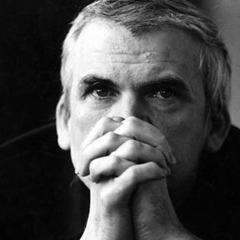
Milan Kundera

Milan Kundera Quotes

Writer

Filter quotes by topic

Famous Milan Kundera Quotes

“The sense of modernism is often seen in the determination of each of the arts to come as close as possible to its own particular nature, its essence. For instance, lyric poetry rejected anything rhetorical, didactic, embellishing, so as to set flowing the pure fount of poetic fantasy. Painting renounced its documentary, mimetic function, whatever might be expressed by some other medium (for instance, photography). And the novel? It too refuses to exist as illustration of a historical era, as description of society, as defense of an ideology, and instead puts itself exclusively at the service of “what only the novel can say.”

“He looks at houses, chateaus, forests, and thinks about the countless generations who used to see those things and who are gone now; and he understands that everything he is seeing is oblivion; pure oblivion, the oblivion whose absolute state will soon be achieved, the moment he himself is gone. And again I think about the obvious idea (that astoundingly obvious idea) that everything that exists (nation, thought, music) can also not exist.”

“For Sabina, living in truth, lying neither to ourselves nor to others, was possible only away from the public: the moment someone keeps an eye on what we do, we involuntarily make allowances for that eye, and nothing we do is truthful. Having a public, keeping a public in mind, means living in lies. Sabina despised literature in which people give away all kinds of intimate secrets about themselves and their friends. A man who loses his privacy loses everything, Sabina thought. And a man who gives it up of his own free will is a monster.”

“The novel was born with the Modern Era, which made man, to quote Heidegger, the "only real subject," the ground for everything. It is largely through the novel that man as an individual was established on the European scene. Away from the novel, in our real lives, we know very little about our parents as they were before our birth; we have only fragmentary knowledge of the people close to us: we see them come and go and scarcely have they vanished than their place is taken over by others: they form a long line of replaceable beings. Only the novel separates out an individual, trains a light on his biography, his ideas, his feelings, makes him irreplaceable: makes him the center of everything.”

“Sabina saw another river flow, another semantic river: each time the same object would give rise to a new meaning, though all former meanings would resonate (like an echo, like a parade of echoes) together with the new one. Each new experience would resound, each time enriching the harmony. … Now, perhaps, we are in a better position to understand the abyss separating Sabina and Franz: he listened eagerly to the story of her life and she was equally eager to hear the story of his, but although they had a clear understanding of the logical meaning of the words they exchanged, they failed to hear the semantic susurrus of the river flowing through them.”

“It is precisely when their interior worlds change shape that Bezukhov and Bolkonsky are confirmed as individuals; that they surprise; that they make themselves different; that their freedom catches fire, and with it the identity of their selves; these are moments of poetry: they experience them with such intensity that the whole world rushes forward to meet them with an intoxicating parade of wondrous details. In Tolstoy, man is the more himself, the more an individual, when he has the strength, the imagination, the intelligence, to transform himself. By contrast, the people I see changing their attitude toward Lenin, Europe, and so on expose their nonindividuality. This change is neither their own creation nor their own invention, not caprice or surprise or thought or madness; it has no poetry; it is nothing but a very prosaic adjustment to the changing spirit of History. That is why they don't even notice it; in the final analysis, they always stay the same: always in the right, always thinking what, in their milieu, a person is supposed to think; they change not in order to draw closer to some essential self but in order to merge with everyone else; changing lets them stay unchanged. Another way of expressing it: they change their mind in accordance with the invisible tribunal that is also changing its mind; their change is thus simply a bet on what the tribunal will proclaim to be the truth tomorrow.”

“There comes a moment when the image of our life parts company with the life itself, stands free, and, little by little, begins to rule us. Already in The Joke: “I came to realize that there was no power capable of changing the image of my person lodged somewhere in the supreme court of human destinies; that this image (even though it bore no resemblance to me) was much more real than my actual self; that I was its shadow and not it mine; that I had no right to accuse it of bearing no resemblance to me, but rather that it was I who was guilty of the nonresemblance; and that the nonresemblance was my cross, which I could not unload on anyone else, which was mine alone to bear.” And in The Book of Laughter and Forgetting: “Destiny has no intention of lifting a finger for Mirek (for his happiness, his security, his good spirits, his health), whereas Mirek is ready to do everything for his destiny (for its grandeur, its clarity, its beauty, its style, its intelligible meaning). He felt responsible for his destiny, but his destiny did not feel responsible for him.”

“It seemed to me an error in reasoning for a man to isolate a woman he loves from all the circumstances in which he met her and in which she lives, to try, with dogged inner concentration, to purify her of everything that is not her self, which is to say also of the story that they lived through together and that gives their ove its shape. After all, what I love in a woman is not what she is in and for herself, but the side of herself she turns toward me, what she is for me. I love her as a character in our common love story.”

“The man raised his glass, 'To you!' Can't you think of a wittier toast?' Something was beginning to irritate him about the girl's game. Now sitting face to face with her, he realized it wasn't just the words which were turning her into a stranger, but that her whole persona had changed, the movements of her body and her facial expression, and that she unpalatably and faithfully resembled that type of woman whom he knew so well and for whom he felt some aversion. And so (holding his glass in his raised hand), he corrected his toast: 'O.K., then I won't drink to you, but to your kind, in which are combined so successfully the better qualities of the animal and the worse aspects of the human being.”

“Because misogynists are the best of men.” All the poets reacted to these words with hooting. Boccaccio was forced to raise his voice: “Please understand me. Misogynists don’t despise women. Misogynists don’t like femininity. Men have always been divided into two categories. Worshipers of women, otherwise known as poets, and misogynists, or, more accurately, gynophobes. Worshipers or poets revere traditional feminine values such as feelings, the home, motherhood, fertility, sacred flashes of hysteria, and the divine voice of nature within us, while in misogynists or gynophobes these values inspire a touch of terror. Worshipers revere women’s femininity, while misogynists always prefer women to femininity. Don’t forget: a woman can be happy only with a misogynist. No woman has ever been happy with any of you!”

“Orwell's 1984 [...] is political thought disguised as a novel; the thinking is certainly lucid and correct, but it is distorted by its guise as a novel, which renders it imprecise and vague. [...] the situations and the characters are as flat as a poster. The pernicious influence of Orwell's novel resides in its implacable reduction of a reality to its political dimension alone, and in its reduction of that dimension to what is exemplarily negative about it. I refuse to forgive this reduction on the grounds that it was useful as propaganda in the struggle against totalitarian evil. For that evil is, precisely, the reduction of life to politics and of politics to propaganda. So despite its intentions, Orwell's novel itself joins in the totalitarian spirit, the spirit of propaganda. It reduces (and teaches others to reduce) the life of a hated society to the simple listing of its crimes.”

“We can never establish with certainty what part of our relations with others is the result of our emotions—love, antipathy, charity, or malice—and what part is determined by the constant power play among individuals. True human goodness, in all its purity and freedom, can come to the fore only when its recipient has no power. Mankind's true moral test, its fundamental test (which lies deeply buried from view), consists of its attitude towards those who are at its mercy: animals. And in this respect mankind has suffered a fundamental debacle, a debacle so fundamental that all others stem from it.”

“They walked along in silence. Silence was the only way of not thinking about Karenin in the past tense. They did not let him out of their sight; they were with him constantly, waiting for him to smile. But he did not smile; he merely walked with them, limping along on his three legs. He's just doing it for us, said Tereza. He didn't want to go for a walk. He's just doing it to make us happy. It was sad, what she said, yet without realizing it they were happy. They were happy not in spite of their sadness but thanks to it. They were holding hands and both had the same image in their eyes: a limping dog who represented ten years of their lives.”

“Spontaneously, without any theological training, I, a child, grasped the incompatibility of God and shit and thus came to question the basic thesis of Christian anthropology, namely that man was created in God's image. Either/or: either man was created in God's image - and has intestines! - or God lacks intestines and man is not like him. The ancient Gnostics felt as I did at the age of five. In the second century, the Great Gnostic master Valentinus resolved the damnable dilemma by claiming that Jesus "ate and drank, but did not defecate." Shit is a more onerous theological problem than is evil. Since God gave man freedom, we can, if need be, accept the idea that He is not responsible for man's crimes. The responsibility for shit, however, rests entirely with Him, the creator of man.”

“Does he love me? Does he love anyone more than me? Does he love me more than I love him? Perhaps all the questions we ask of love, to measure, test, probe, and save it, have the additional effect of cutting it short. Perhaps the reason we are unable to love is that we yearn to be loved, that is, we demand something (love) from our partner instead of delivering ourselves up to him demand-free and asking for nothing but his company.”

“Someone interrupted him: "Modern art was a movement directed against the bourgeoisie and against its world." "Yes," said Jaromil, "but if it had really been logical in its negation of the contemporary world, it would have had to reckon with its own disappearance. It would have had to know—and it would have had to wish—that the revolution would create a totally new kind of art, an art in its own image." "So you approve," said the woman with the alto voice, "of pulping Baudelaire's poetry, prohibiting all modern literature, and shoving the cubist paintings in the National Gallery into the cellar?" "A revolution is an act of violence," said Jaromil, "that's well known, and surrealism itself knew very well that old-timers have to be brutally kicked off the stage, but it didn't suspect that it was one of them.”

“E qualcos'altro lo elevava: teneva sul tavolo un libro aperto. In quel bar nessuno aveva mai aperto un libro sul tavolo. Un libro era per Tereza il segno di riconoscimento di una fratellanza segreta. Contro il mondo della volgarità che la circondava, essa aveva infatti un’unica difesa: i libri che prendeva in prestito alla biblioteca comunale…”

“They had been talking about his friend Z. when she announced, "If I hadn't met you, I'd certainly have fallen in love with him." Even then, her words had left Tomas in a strange state of melancholy, and now he realized it was only a matter of chance that Tereza loved him and not his friend Z. Apart from her consummated love for Tomas, there were, in the realm of pos­sibility, an infinite number of unconsummated loves for other men. We all reject out of hand the idea that the love of our life may be something light or weightless; we presume our love is what must be, that without it our life would no longer be the same; we feel that Beethoven himself, gloomy and awe-inspir­ing, is playing the "Es muss sein!" to our own great love. Tomas often thought of Tereza's remark about his friend Z. and came to the conclusion that the love story of his life exemplified not "Es muss sein!" (It must be so), but rather "Es konnte auch anders sein" (It could just as well be otherwise).”

“She knew only too well that the song was a beautiful lie. As soon as kitsch is recognized for the lie it is, it moves into the context of non-kitsch, thus losing its authoritarian power and becoming as touching as any other human weakness. For none among us is superman enough to escape kitsch completely. No matter how we scorn it, kitsch is an integral part of the human condition.”

“Keep this in mind: it is our religion to praise life. The word "life” is the king of words. The king­word surrounded by other grand words. The word "adventure”! The word "future”! And the word "hope”! By the way, do you know the code name for the atomic bomb they dropped on Hiroshima? "Little Boy”! That's a genius, the fellow who invented that code! They couldn't have dreamed up a better one. Little boy, kid, tyke, tot - there's no word that's more tender, more touching, more loaded with future.”

“[…] without much ardor but quite unmistakably, she was writhing her hips as if she were dancing. When he was very close, he saw' her gaping mouth: she was yawning lengthily, insatiably: the great open hole was rocking gently atop die mechanically dancing body. Jean-Marc thought: she’s dancing and she’s bored. He reached the seawall: down below, on the beach, he saw men with their heads thrown back releasing kites into the air. They were doing it with passion, and Jean-Marc recalled his old theory: there are three kinds of boredom: passive boredom: the girl dancing and yawning; active boredom: kite-lovers; and rebellious boredom: young people burning cars and smashing shop windows.”

“The unification of the planet's history, that humanist dream which God has spitefully allowed to come true, has been accompanied by a process of dizzying reduction. True, the termites of reduction have always gnawed away at life: even the greatest love ends up as a skeleton of feeble memories. But the character of modern society hideously exacerbates this curse: it reduces man's life to its social function; the history of a people to a small set of events that are themselves reduced to a tendentious interpretation; social life is reduced to political struggle, and that in turn to the confrontation of just two great global powers.”

“Through ecstasy, emotion reaches its climax, and thereby at the same time its negation (its oblivion). Ecstasy means being "outside oneself," as indicated by the etymology of the Greek word: the act of leaving one's position (stasis). To be "outside oneself" does not mean outside the present moment, like a dreamer escaping into the past or the future. Just the opposite: ecstasy is absolute identity with the present instant, total forgetting of past and future. If we obliterate the future and the past, the present moment stands in empty space, outside life and its chronology, outside time and independent of it (this is why it can be likened to eternity, which too is the negation of time). [...] Man desires eternity, but all he can get is its imitation: the instant of ecstasy. [...] Living is a perpetual heavy effort not to lose sight of ourselves, to stay solidly present in ourselves, in our stasis. Step outside ourselves for a mere instant, and we verge on death's dominion.”