Quotessence
Home / Quotes / Quote by Gary Snyder

Quote by Gary Snyder

Work

Earth House Hold: Technical Notes & Queries to Fellow Dharma Revolutionaries

This book offers in-depth technical insights and discussions aimed at fellow Dharma Revolutionaries, exploring various aspects of the movement and its practices. more

Author
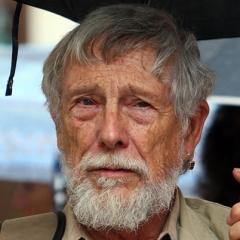
Gary Snyder
Gary Snyder

Gary Snyder is an influential American poet born on May 8, 1930. His poetry, deeply influenced by nature and Zen Buddhism, is considered one of the leading figures in American environmental poetry. more

You May Also Like

“No doubt you’ve heard the phrase 'ignorance of the law is no excuse’, and are probably familiar with the statist meaning of that phrase: Being ignorant of a law is no excuse for breaking it. However 'ignorance of the law is no excuse' also has a less-well-known libertarian meaning: This is an ignorant law and there’s no excuse for it!”

“And our topic is topsy-turvy: civil disobedience. As soon as you say the topic is civil disobedience, you are saying our problem is civil disobedience. That is not our problem.... Our problem is civil obedience. Our problem is the numbers of people all over the world who have obeyed the dictates of the leaders of their government and have gone to war, and millions have been killed because of this obedience. And our problem is that scene in All Quiet on the Western Front where the schoolboys march off dutifully in a line to war. Our problem is that people are obedient all over the world, in the face of poverty and starvation and stupidity, and war and cruelty. Our problem is that people are obedient while the jails are full of petty thieves, and all the while the grand thieves are running the country. That's our problem.”

“At the same time there is reason to think that Gandhi, who after all was born in 1869, did not understand the nature of totalitarianism and saw everything in terms of his own struggle against the British government. The important point here is not so much that the British treated him forbearingly as that he was always able to command publicity. As can be seen from the phrase quoted above, he believed in ‘arousing the world’, which is only possible if the world gets a chance to hear what you are doing. It is difficult to see how Gandhi’s methods could be applied in a country where opponents of the regime disappear in the middle of the night and are never heard of again. Without a free press and the right of assembly, it is impossible not merely to appeal to outside opinion, but to bring a mass movement into being, or even to make your intentions known to your adversary. Is there a Gandhi in Russia at this moment? And if there is, what is he accomplishing? The Russian masses could only practise civil disobedience if the same idea happened to occur to all of them simultaneously, and even then, to judge by the history of the Ukraine famine, it would make no difference.”

“Civil disobedience is urged not to destroy the United States but because the government is now poorly organized to achieve democracy. The aim of such a movement always will be to improve the nature of the government, to urge and counsel resistance to military Jim Crow in the interest of a higher law--the principle of equality and justice upon which real community and security depend.”