Quotessence
Home / Quotes / Quote by Huma Abedin

Quote by Huma Abedin

“From Hillary Clinton, I have learned all kinds of things. How to be confident, brave, unfailingly empathetic, future-focused, tough, and gracious. She and I have had countless adventures over the past twenty-five years and who knows what else lies in the future, but I am still certain about one thing. Hillary Clinton would have been an exceptional President of the United States. Maybe one of the best presidents. I say that with even more conviction and resolve today than when I believed it as a starry-eyed young woman. The overarching quest of her public life has always been how to help every man, woman, and child reach their full potential. That purpose drove every policy rollout, every bill in the Senate, every speech she delivered, every town and country she visited, every book she wrote. Her focus was always how to give each child the opportunity to grow and flourish, every parent the tools to raise healthy, educated children, every person the right to live in dignity, every worker the protections and rights to succeed and thrive. As president, she would have reached across the aisle and forced divergent opinions to the table to help all Americans. She would have served her country, not herself. Maybe it won't happen in her lifetime or mine, but I'm confident that history will remember her as one of the American Greats.”

Quote by Huma Abedin

Work

Both/And: A Memoir

Browse quotes and source details for this work. more

Author
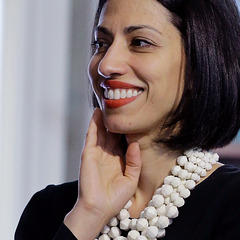
Huma Abedin
Huma Abedin

Huma Abedin is a distinguished political figure born on July 28, 1976. She has served as a close advisor to several high-profile political figures, including former United States Secretary of State Hillary Clinton. Abedin has been involved in politics and diplomacy for over two decades, playing a pivotal role in shaping policy and communication strategies. more

You May Also Like

“Emotions were running so high in the country that I feared there was going to be some violence before the election. I even half-jokingly said to Hillary one day in October that it was beginning to feel like we were upsetting some cosmic natural balance by seeking to "upend the patriarchy." I didn't really believe it, of course, but a large part of the country seemed to believe Hillary represented an existential threat to the proper order of things.”

“IN 1993, after First Lady Hillary Rodham Clinton put an end to smoking in the White House, Bill Clinton would sometimes retreat there to smoke a cigar in a celebratory moment, as he did after the United States rescued a soldier in Bosnia.”

“How frustrating must it have been for the most qualified candidate in US history to lose to a man so incompetent, dangerous, and cartoonish that he is living satire. That enough people in the right places preferred an ignorant, racist, misogynist, dangerous imbecile (not to mention an accused rapist) to a woman with decades of political experience is proof of how much further we have to go. Hillary Clinton has endured a lifetime of abuse about her looks (they were even blamed for her husband's infidelities), her 'shrill' personality, her mannishness, her hawkishness, her sensitivity (heaven forbid a person be seen to cry once in a while) and her general 'lack of appeal'. People still seem to be baffled by the idea that a woman could be powerful in her own right rather than have it bestowed on her by the male gaze. I'm not saying she's above critique or that none of it is fair -- I'm saying there's a flavor to it that is purely do to her being a woman that isn't found in critiques of men with similar political leanings.”

“No military organization can exist without bureaucracy, as distasteful as it may be, and no professional organization should tolerate inefficient administration of bureaucratic requirements. As mentioned above, such problems deplete morale and are a true risk to the operational effectiveness of a command.”

“The wounding legacy of segregation and growing up knowing adults who had worked for civil rights and equal opportunities for African Americans was part of what made me understand that many kids in my community and around the world were still treated differently because of the color of their skin. My mothers work on behalf of girls and women, first in Arkansas and later around the world, helped me understand how being born a girl is often seen as a reason to deny someone the right to go to school or make her own decisions, or even about who or when to marry. One of the unique things about SEWA [Self-Employed Women's Association] is that it brings together Muslim and Hindu women in a part of the world where fighting between people from different religious backgrounds has cost countless lives, both between countries and within India. Women from all different backgrounds told us how they'd learned how much more they had in common than they'd first thought because of their different religions. Their support for each other gave them the confidence to stand up to bullying and harassment, and the relationships they'd built helped prevent violence between Hindus and Muslims, because they saw each other as friends and real people, not only as representatives of different religions.”