Quotessence
Home / Quotes / Quote by Thomas Malthus

Quote by Thomas Malthus

Work

An Essay on the Principle of Population

Written by Thomas Robert Malthus, this book delves into the implications of population growth on food supply and the potential for societal crises. It analyzes the historical and contemporary factors influencing population dynamics and proposes economic and social strategies to address potential issues. more

Author
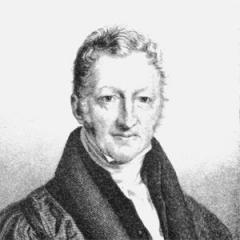
Thomas Malthus
Thomas Malthus

Thomas Malthus, a British economist and demographer, was born on February 14, 1766, in Surrey, England, and died on December 23, 1834. Malthus is known for his theory of population, which posits that population growth will outstrip food supply, leading to poverty and suffering. more

You May Also Like

“If we start to think about trust as a public good (like clean air and water), we see that we can all benefit from higher levels of trust in terms of communicating with others, making financial transitions smoother, simplifying contracts, and many other business and social activities. Without constant suspicion, we can get more out of our exchanges with others while spending less time making sure that others will fulfill their promises to us. Yet as the tragedy of commons exemplifies, in the short term it is beneficial for each individual to violate and take advantage of the established trust. I suspect that most people and companies miss or ignore the fact that trust is an important public resource and that losing it can have long-term negative consequences for everyone involved. It doesn't take much to violate trust. Just a few bad players in the market can spoil it for everyone else.”

“When somebody summarizes an argument thoughtfully before offering a counterargument, the resulting debate tends to be more meaningful and productive. Much of what passes for argument in our society consists of people badly misrepresenting each other's arguments and responding to points that another person is not making. This inevitably leads to frustration and anger and a feeling of being rhetorically manipulated instead of honestly challenged. Correctly paraphrasing somebody's position makes it much harder to misrepresent that position while trying to argue against it.”

“Friendship: not a marathon of years but a sprint of sincerity. It's not about who's been around the longest, but who showed up with pizza at 2 AM when life got messy. Let's face it: Anyone can count years, but only true friends count on each other. So, here's to those who bring the laughs, the late-night talks, and maybe even bail money if needed. They're not just friends; they're the keepers of sanity and partners in crime”

“Eastward and westward storms are breaking,--great, ugly whirlwinds of hatred and blood and cruelty. I will not believe them inevitable.”

“Reading contemporary accounts brings home the fact that of any battle or campaign there are at least for different versions. One is that of those who fought in it, two is of the generals who commanded it, three is of those who reported on it at the time and made what they could of a mass of confused and often misleading information, and four is the version of those who had a theory about it and reported those facts which happened to fit the version they were trying to portray.”

“Reading contemporary accounts brings home the fact that of any battle or campaign there are at least for different versions. One is that of those who fought in it, two is of the generals who commanded it, three is of those who reported on it at the time and made what they could of a mass of confused and often misleading information, and four is the version of those who had a theory about it and reported those facts which happened to fit the version they were trying to portray." ~The Crimean War: A reappraisal”

“Why did you fight as you did? Why did you risk death so often? Did you do it for the good of the country? ..The war wasn't for the good of the country. It was for the benefit of private mercantile interests, fueled by by the conceit of politicians. You fought for the glory and medals then? Hardly. Then why? ...Everything I did was for my men. For the noncommissioned ones who had joined the army to avoid starvation or the workhouse. And for the junior officers who were experienced and long-serving but hadn't the means to buy a commission. I had the command only because I had money to purchase it, not for reason of merit. Absurd. And the men in my company, the poor bastards, were supposed to follow me , whether I proved to be incompetent, an imbecile or a coward. They had no choice but to depend on me. And therefore I had no choice but to try and be the leader they needed. I needed to keep them alive... I failed far too often. And now I would love for someone to tell me how to live with their deaths on my conscience.”