Quotessence
Home / Quotes / Quote by John Lewis

Quote by John Lewis

Work

Across That Bridge: A Vision for Change and the Future of America

Browse quotes and source details for this work. more

Author
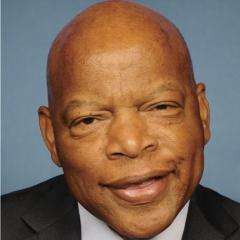
John Lewis
John Lewis

John Lewis, an American politician born on February 21, 1940, and passed away in 2016. He was a civil rights activist and served as a U.S. Representative. Throughout his life, he actively participated in the American civil rights movement and made significant contributions to the cause of equality and justice. more

You May Also Like

“We all cope with fear and uncertainty differently. A great many conservatives are dealing with their fears about a changing and destabilizing world by attempting to force back the clock. But if the Right specializes in turning backward, the Left specializes in turning inward and firing on each other in a circular hail of blame.”

“The problem with Trump voters is, they're so dumb, they don't even know how much stuff they don't know. They just assume no one else knows more about evolution or global warming than they do.”

“It is not for nothing that that vivacious lady is standing up there with the torch of liberty in her hand, as a beacon to the whole world - take a look at the world through her eyes, if you really want to see something – and you won’t just see scenery – you’ll see the whole parade of what humans have carved out for themselves after centuries of fighting – fighting so they could stand on their own two feet, free and decent, no matter their race, religion and creed.”

“It's funny how, in this journey of life, even though we may begin at different times and places, our paths cross with others so that we may share our love, compassion, observations, and hope. This is a design of God that I appreciate and cherish.”

“Wittgenstein wrote a comprehensive critique of the Scottish anthropologist J. G. Frazer's masterpiece "The Golden Bough" (1890), a comparative study of religion and mythology. One of Wittgenstein's main objections was that Frazer ascribes the natives he discusses with irrational beliefs for which there is no evidence: for example, that a certain ritual will make it rain. The problem is that Frazer is unable to see what the natives are actually doing. Wittgenstein states: "Frazer is much more savage than most of his savages... His explanations of primitive practices are much cruder than the meaning of these practices themselves." While Frazer believes that the natives' actions are based on mistaken beliefs about causal relationships, Wittgenstein suggests that they are not based on such beliefs at all. Once, after a very bad game, I smashed my tennis racket. Had my opponent thought like Frazer, he would have believed that my action was a ritual sacrifice aimed at changing the outcome of the tournament for me. But my action was not based on any such expectation. It was simply an immature expression of anger and disappointment. The most reasonable understanding of the natives' ritual practices involves considering them as expressions of hope, among other things, not as irrational notions of causal relationships. Our idea of causation stems from us observing regularities. We will have repeatedly seen that A is followed by B. What regularities would have led the natives to see a causal relationship between a specific ritual and a specific natural phenomenon such as rain? Is is unlikely that rain was usually brought about by a specific dance, and the natives must have seen that it sometimes rains despite no ritual being performed. Not least, the natives should have danced a lot during the driest parts of the year, but they didn't. So it's far more plausible to consider this dance an expression of hoping for rain. From that perspective there is nothing irrational about the natives' actions. The dancing is a shared expression of their understanding that the desired rain might come.”