Quotessence
Home / Quotes / Quote by Ursula K. Le Guin

Quote by Ursula K. Le Guin

“Aeneas' mother is a star?" "No; a goddess." I said cautiously, "Venus is the power that we invoke in spring, in the garden, when things begin growing. And we call the evening star Venus." He thought it over. Perhaps having grown up in the country, among pagans like me, helped him understand my bewilderment. "So do we, he said. "But Venus also became more...With the help of the Greeks. They call her Aphrodite...There was a great poet who praised her in Latin. Delight of men and gods, he called her, dear nurturer. Under the sliding star signs she fills the ship-laden sea and the fruitful earth with her being; through her the generations are conceived and rise up to see the sun; from her the storm clouds flee; to her the earth, the skillful maker, offers flowers. The wide levels of the sea smile at her, and all the quiet sky shines and streams with light..." It was the Venus I had prayed to, it was my prayer, though I had no such words. They filled my eyes with tears and my heart with inexpressible joy.”

Quote by Ursula K. Le Guin

Book:Lavinia

Work

Lavinia

This novel offers a contemporary retelling of the character Lavinia, a figure from Virgil's epic, exploring her experiences and the world she inhabited during the fall of Troy. The story delves into Lavinia's personal journey, her relationships, and the historical events surrounding her life. more

Author
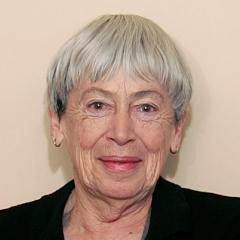
Ursula K. Le Guin
Ursula K. Le Guin

Ursula K. Le Guin, born on October 21, 1929, is an esteemed American author of science fiction and fantasy. Known for her profound philosophical insights, rich imagination, and unique narrative style, Le Guin's works have won numerous literary awards and have had a significant impact on science fiction and fantasy literature. Her most famous works include the 'Earthsea' series and 'The Left Hand of Darkness', which have won her awards such as the Nebula and Hugo Awards, and she has also received the National Book Award for lifetime achievement for her contributions to literature. more

You May Also Like

“It must be understood that in some cases the process by which a god or goddess degenerates into a fairy may occupy centuries, and that in the passage of generations such an alteration may be brought about in appearance and traits as to make it seem impossible that any relationship actually exists between the old form and the new. This may be accounted for by the circumstance that in gradually assuming the traits of fairyhood the god or goddess may also have taken on the characteristics of fairies which Already existed in the minds of the folk, the elves of a past age, who were already elves at a period when he or she still flourished in the full vigour of godhead. For in one sense Faerie represents a species of limbo, a great abyss of traditional material, into which every kind of ancient belief came to be cast as the acceptance of one new faith after another dictated the abandonment of forms and ideas unacceptable to its doctrines. The difference between god and fairy is indeed the difference between religion and folk-lore.”

“Then the woman in the bed sat up and looked about her with wild eyes; and the oldest of the old men said: 'Lady, we have come to write down the names of the immortals,’ and at his words a look of great joy came into her face. Presently she, began to speak slowly, and yet eagerly, as though she knew she had but a little while to live, and, in English, with the accent of their own country; and she told them the secret names of the immortals of many lands, and of the colours, and odours, and weapons, and instruments of music and instruments of handicraft they held dearest; but most about the immortals of Ireland and of their love for the cauldron, and the whetstone, and the sword, and the spear, and the hills of the Shee, and the horns of the moon, and the Grey Wind, and the Yellow Wind, and the Black Wind, and the Red Wind. ("The Adoration of the Magi")”

“As Mr. R. U. Sayee has well said: 'It should be clear a priori that fairy lore must have developed as a result of modifications and accretions received in different countries and at many periods, though we must not overlook the part played by tradition in providing a mould that to some extent determines the nature of later additions.' It must also be self-evident that a great deal of confusion has been caused by the assumption that some spirit-types were fairies which in a more definite sense are certainly not of elfin provenance. In some epochs, indeed, Faerie appears to have been regarded as a species of limbo to which all 'pagan' spirits - to say nothing of defeated gods, monsters, and demons - could be banished, along with the personnel of Olympus and the rout of witchcraft. Such types, however, are usually fairly easy of detection.”