Quotessence
Home / Quotes / Quote by Rosa Luxemburg

Quote by Rosa Luxemburg

Work

The Letters of Rosa Luxemburg

Browse quotes and source details for this work. more

Author
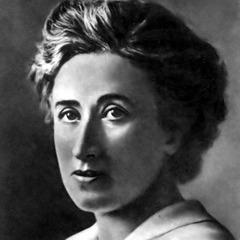
Rosa Luxemburg
Rosa Luxemburg

Rosa Luxemburg (March 5, 1871 – January 15, 1919) was a Polish-German Marxist philosopher, economist, and revolutionary. She was a key figure in the German Social Democratic Party and a co-founder of the Communist Party of Germany. Known for her critique of capitalism, theory of imperialism, and advocacy for socialist democracy, she opposed World War I and was imprisoned for her anti-war activities. Luxemburg was murdered by right-wing paramilitaries during the German Revolution of 1919. Her works, including 'The Accumulation of Capital' and 'The Russian Revolution,' remain influential in Marxist theory. more

You May Also Like

“Everything that is tearing us down today will become a memory, and this memory will be shared as an anecdote or a story or a poem or a play or a warning. It will be shared with another human being, who will then understand that he is not alone in his sadness. This is why we show up for others and tell our tales and listen to others. The great congregation meets daily, and you are someone’s angel today. (In an Interview with James Grissom)”

“The quiet ones, the introverts, are uniquely gifted. We have tremendous patience and empathy. We don’t need to say much, yet we’re able to build deep connections and rapport with those around us. The act of displaying Quiet Confidence is much easier to cultivate than we think. It’s built-in, a bundled accessory, we simply have to activate it!”

“When your kids fail—and they will, no matter how bright or talented they are—you can meet them with empathy and understanding as well as help them learn how to treat themselves with their own inner voice of empathy and understanding.”

“The autistic form of life does not conform to assumed social normativity and does not easily extend outward into the social, leading to a 'double empathy problem' between people of diverse dispositions, that is, both parties struggle to understand and relate to one another. Such differences in presentation can lead to dyspathic reactions and stigma, often leading to ill-fated attempts at normalisation and a continuing vicious cycle of psycho-emotional disablement.”

“In one brain imaging study, psychology professor Matthew Lieberman of the University of California, Los Angeles, found that when people are shown photos of faces expressing strong emotion, the brain shows greater activity in the amygdala, the part that generates fear. But when they are asked to label the emotion, the activity moves to the areas that govern rational thinking. In other words, labeling an emotion—applying rational words to a fear—disrupts its raw intensity.”

“إذا لا تملك القدرة لكي تعبر عن عواطفك لغيرك, ولاتسطيع أن تسيطر على سلبيات الإنفعال العصبي ، و إذا لم تكن قادر على إدارة العواطف المؤلمة والخاصة بك ، أو لاتملك الحساسية للتتعاطف مع غيرك ، فأنت إذا لا تملك الوعي الذاتي مهما كنت ذكيا, وبعيد عن أي أمر يمكن أن يكون التعاطف في علاقات فعالة .”