Quotessence
Home / Quotes / Quote by Christopher Morley

Quote by Christopher Morley

Author

Christopher Morley
Christopher Morley

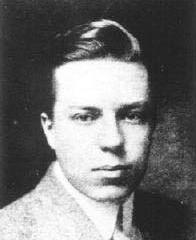
Christopher Morley was an American journalist and writer, born on May 5, 1890, in Pennsylvania, and died on March 28, 1957. Known for his humorous and witty writing style, Morley is considered an important figure in American literature of the 20th century. more

You May Also Like

“If we do not stop these mar-makers not,...it will soon be too late. We are the only nation that can halt this crusade. It might be too late in America, but it isn't too late here. Without British support the whole scheme would collapse. For that reason the future of all nations depends upon the policy which is decided in this House. More than that, the final position of Britain in the world is being decided. If we support these anti-Communist crusades through the world as we have supported it in Greece, then our good name and existence will be threatened by the hatred of all free-thinking men. We cannot suppress all desire in Europe and Asia for social change by branding it communism from Russia and persecuting its supporters. Social change doesn't have to come from Russia, whatever the Foreign Office or the Americans say. It is a product of the miserable conditions under which the majority of the earth's population exist. There are fighters for social change in every land, here as well as anywhere.... We Socialists are among them. That is the reason for our predominance in the House to-day. The very men that we try to suppress in other countries are asking for far less liberty than we enjoy here, far less social change than we Socialists hope to initiate in Great Britain. Are we going to betray these men by labelling them Communists and crushing them wherever we find them until we have launched ourselves at Russia herself in a war that will wipe this island off the face of the earth? The American imperialists say that this is the American Century. ARe we to sacrifice ourselves for that great ideal, or are we to stand beside the people of Europe and Asia and other lands who seek independence, economic stability, self-determination, and the right to conduct their own affairs? Are we going to partake in an anti-Red campaign when we ourselves are Reds? ...... Some among us might think that there is political expediency in following this anti-Russian crusade without really getting enmeshed in it, creating a Third Force in Europe of their friends, a balancing force for power politics. In that you have the real policy of our Government to-day. But how can we avoid final involvement? Our American vanguard will stop at nothing. They hold their atom bomb aloft with nervous fingers. It has become their talisman and their faith. It is their new weapon of anti-Communism, a more efficient Belsen and Maidenek. Its first usage was morally anti-Russian. It was used to end Japan quickly so that Russia would play no part in the final settlement with that country. No doubt they would have used it on Russia already if they could be certain that Russian did not have an equal or better atomic weapon. That terrible uncertainty goads them into fiercer political and economic activity against the world's grim defenders of great liberties. In that you have the heart of this American imperial desperation. They cannot defeat the people of Europe and Asia with the atomic bomb alone. They cannot win unless we lend them our name and our support and our political cunning. To-day they have British support, in policy as well as in international councils where the decisions of peace and security are being made. With our support America is undermining every international conference with its anti-Russian politics.”

“And at this very moment, like a miracle, the rail-bus appeared. We waved our arms frantically, hardly daring to hope that it would stop. It did stop. We scrambled thankfully on board. That is the irony of travel. You spend your boyhood dreaming of a magic, impossibly distant day when you will cross the Equator, when your eyes will behold Quito. And then, in the slow prosaic process of life, that day undramatically dawns—and finds you sleepy, hungry and dull. The Equator is just another valley; you aren’t sure which and you don’t much care. Quito is just another railroad station, with fuss about baggage and taxis and tips. And the only comforting reality, amidst all this picturesque noisy strangeness, is to find a clean pension run by Czech refugees and sit down in a cozy Central European parlor to a lunch of well-cooked Wiener Schnitzel.”

“I’ll find out whatever I can about this Frank. Would the girls go to the police if they were in danger, do you think?” “I can’t say,” Shyla replied, but her head was shaking as she spoke. That was hardly a surprise. A lot of Aboriginal people were suspicious of the police, or gunjies, as Shyla sometimes called them. Through conversations with Shyla, Billie had some of the picture—how contacting the authorities about anything might lead to being arrested for something else, or having the men taken, or having the Aborigines Welfare Board take children away “for their own good.” Stuff like that tended to ensure that trust was in short supply. That long and troubled history had not been forgotten and had created understandable tension between Aboriginal communities and the white authorities. That couldn’t simply vanish overnight.”