Quotessence
Home / Quotes / Quote by John Steinbeck

Quote by John Steinbeck

Work

Of Mice and Men

This seminal work by John Steinbeck delves into the profound bond between George, a mentally disabled man, and Lennie, a giant with a childlike temperament. Their journey through the harsh realities of the Depression era highlights the struggle for survival and the elusive nature of happiness. more
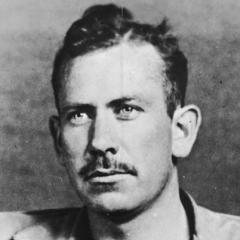
Author

John Steinbeck
John Steinbeck

John Steinbeck was an American author renowned for his profound depiction of American society and the lives of farmers. His works often explore themes of poverty, social injustice, and human nature. Steinbeck was awarded the Nobel Prize in Literature in 1962 for his significant contribution to American literature. more

You May Also Like

“In the final analysis, the relation of the individual to society must not be conceived after the atomistic and mechanistic pattern of bourgeois individualism which destroys the organic social totality, or after the biological and animal pattern of the statist or racist totalitarian conception which swallows up the person, here reduced to a mere histological element of Behemoth or Leviathan, in the body of the state, or after the biological and industrial pattern of the Communistic conception which ordains the entire person, like a worker in the great human hive, to the proper work of the social whole. The relation of the individual to society must be conceived after an irreducibly human and specifically ethicosocial pattern, that is, personalist and communalist at the same time; the organization to be accomplished is one of liberties. But an organization of liberty is is unthinkable apart from the amoral realities of justice and civil amity, which, on the natural and temporal plane, correspond to what the Gospel calls brotherly love on the spiritual and supernatural plane. This brings us back to our considerations of the manner in which the paradox of social life is resolved in a progressive movement that will never be terminated here-below. There is a common work to be accomplished by the social whole as such. This whole, of which human person are the parts, is not ‘neutral’ but is itself committed and bound by a temporal vocation. Thus the persons are subordinated to this common work. Nevertheless, not only in the political order, is it essential to the common good to flow back upon the persons, but also in another order where that which is most profound in the person, its supra-temporal vocation and the goods connected with it, is a transcendent end, it is essential that society itself and its common work are indirectly subordinated. This follows from the fact that the principal value of the common work of society is the freedom of expansion of the person together with all the guarantees which this freedom implies and the diffusion of good that flows from it. In short, the political common good is a common good of human persons. And thus it turns out that, in subordinating oneself to this common work, by the grace of justice and amity, each one of us is trill subordinated to the good of persons, to the accomplishment of the personal life of others an, at the same time, to the interior dignity of ones own person. But for this solution to be practical, there must be full recognition in the city of the true nature of the common work and, at the same time, recognition also of the importance and political worth--so nicely perceived by Aristotle--of the virtue of amity.”

“Joseph is an example of true patience and endurance in the plan of God. From the moment we are conceived in the womb, our destiny is being shaped by God the Father. From the life of Joseph we can learn what it is to suffer for God, what it is to truly die to self and the blessing that God bestows upon those who lay down their lives in service to Him and the resurrection power of new beginnings that only God can bring to pass by and through His Spirit of grace.”