Quotessence
Home / Quotes / Quote by Bayard Rustin

Quote by Bayard Rustin

“The needs of the black community for adequate jobs, housing, and education can be met only by developing a political strategy that will attract a majority of Americans to a program for social change. There are whites who are unemployed and white workers whose real income is steadily decreasing as the cost of living rises. Both these groups share with blacks the desire for increased and upgraded employment opportunities. Let us build a movement with them. there are whites living in substandard housing and paying exorbitant rents. Their children attend schools that are overcrowded and understaffed. They share with blacks the desire for massively funded programs of housing and education. Let us build a movement with them also. And there are those more affluent whites of liberal persuasion who sincerely desire social justice. They too should be our allies. These are positive points around which a political majority can be built. Such a strategy is the only means by which black people will achieve social and economic equality within the context of contemporary American society.”

Quote by Bayard Rustin

Work

Down the Line: The Collected Writings of Bayard Rustin

Browse quotes and source details for this work. more

Author
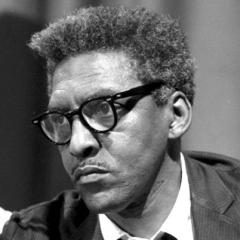
Bayard Rustin
Bayard Rustin

Bayard Rustin was a prominent African American civil rights activist who played a significant role in the American civil rights movement. He was a strategist and advisor to many civil rights leaders, including Martin Luther King Jr. Rustin was a key figure in the organization of the 1963 March on Washington for Jobs and Freedom, one of the largest political protests in U.S. history. He was also a leader in the gay rights movement and advocated for nonviolent protest and civil disobedience. more

You May Also Like

“If only I could cry. I am beyond that. The light, the light, lending itself to empty downtown Saturday, but still the stupid insensate cars flush by oblivious to their stupidity, my silent plea. It isn't Mexico. It's not Paris. It's a painting by Hopper come to life. I am trapped inside a dead thing. Language is impossible here, even in English. Who has the arrogance to say: I'm mad, this is my crazy view of things, help me. I'm trapped in a silent world, a tableau of forty years ago. The walls are different, the tables, the heights of the veiling and the chairs. I loom above this letter. The view past the rows of cakes in the plate glass window is unfamiliar. I am a ghost. There is nothing now between me and death. Death is the unfamiliarity of everything, the strangeness of the once familiar. The same spatial configurations only the light is hollow, sick. I think I lack the energy to hit expensive discos which I don't know where they are to be rejected tonight. I look passable. My energy's low. I love to dance but despair is not a good muse. This Mexico, babe. Men who don't love you but act wildly as if they do initially. Self-involved, narcissistic men... The men drink and philosophize about pain. The women live it solo and culturelessly. No one cries, except easily, sentimentally. The devil, therefore God, exists. Oaxaca was a pushover compared to this. Pain had boundaries there. Spare us big cities, oh lord!”

“[Sin ese libro], tú no podrías escuchar nada sobre nuestra tradición de resistencia femenina a la opresión, que se remonta a la mujer nativa que tomó los techos de las casas en lo que luego se convertiría en México e "hizo llover dardos y piedras" sobre los invasores españoles. O a la mujer que, en Oaxaca, demandó a su esposo por abuso y logró que su caso llegara a la corte en 1630. O a las mujeres Maya que encerró al cura español en su iglesia por no aceptar que se enterraran a las víctimas mayas de una epidemia de tifus en tierras de la iglesia. O a las masivas "Revueltas del Maíz" de 1962 realizadas por mujeres que se rehusaban a morir de hambre. [Without a book like this] you would not hear about our tradition of female resistance to oppression, going back to Aztec women who took to the rooftops in what later became Mexico City and ‘rained down darts and stones’ on the invading Spainiards. Or the woman who filed suit in Oaxaca against her husband for abuse and had her case heard in court-in 1630! Or the Maya women who lackeed up the local Spanish priest in his church for not having Maya victims of a typhus epidemic buried in church ground. And the massive ‘Corn Riots’ of 1692 by women who refused to starve.”

“England and the English governing class never did call on this absurd deity of race until it seemed, for an instant, that they had no other god to call on… the truth of the whole matter is very simple. Nationality exists, and has nothing in the world to do with race. Nationality is a thing like a church or a secret society. It is the product of the human soul and will; it is a spiritual product. And there are men… who would think anything and do anything rather than admit anything could be a spiritual product.”