Quotessence
Home / Quotes / Quote by Italo Calvino

Quote by Italo Calvino

Work

Mr Palomar

Browse quotes and source details for this work. more
Author

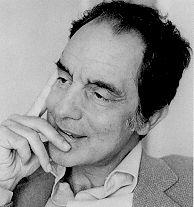
Italo Calvino
Italo Calvino

Italian writer and journalist, known for his unique narrative style and rich imagination. Calvino is considered one of the greatest writers of the 20th century, whose works have had a profound impact on literature both in Italy and around the world. more

You May Also Like

“Nonreaction isn’t about ignoring the problem or suppressing your emotions, but about choosing a more skillful and, dare I say, more eloquent response. It’s about recognizing that your silence can be more disarming than any logical (or illogical) argument.”

“In his moments of lucidity, which would later become increasingly rare and painful, he suggested an explanation of what was happening to him: “I am a guilty man. That is why I am being punished like Abuya's heretical sons, I gazed when I should not have gazed and turned my eyes away when I should not have. I saw a sin committed… a crime…I could have, I should have, done something, called out, shouted, struck a blow. I forgot our precepts, our laws, that require an individual to struggle against evil wherever it appears. I forgot that we can never simply remain spectators, we have no right to stand aside, to keep silent, to let the victim fight the aggressor alone. I forgot so many things that day…That is why I am forgetting other things now. Can there be anything worse than that?” Yes, there was worse, there is worse: to forget that one has forgotten.”

“In the context of conflict resolution, wu wei encourages us to approach disagreements with a sense of controlled (but not controlling) detachment. Instead of imposing our will or trying to micromanage the outcome, we learn to flow with the present moment and allow the situation to resolve itself naturally. This doesn’t mean being passive or indifferent. The practice of wu wei … is about finding a delicate balance between action and inaction. We speak our truth when necessary, but we also recognize when silence is the more prudent and persuasive course of action.”

“Meditation brings a revolution of our innermost being. As we go deeper into the silence of our inner being, desires disappears. Desires exists only on the surface of our consciousness. They are like waves existing on the surface of our consciousness. When you dive deeper into the ocean of our consciousness there are no waves. Then you can come back to the surface of our consciousness, but you cannot lose contact with the center of our inner being. Then you can remain in the world, in the marketplace, and yet remain in tremendous silence. One can be in the crowd, and yet be absolutely alone. One can act with love, silence, joy, truth, freedom and creativity, but without any tension. This is the most fundamental thing for a meditator to be in the world, and yet to not be of it. It is to be in the world, but not allow the world to be in you. Then the whole world becomes a stage, and all relationships become a great drama. Then the meditator becomes the center of the cyclone.”

“Meditation brings all that is really valuable in life. Meditation brings love, silence, joy, truth, freedom and godliness. It makes your heart dance. It makes your being full of song. The meditastor takes life playfully. And if you are not serious then there is never any frustration. If you succeed, good. If you fail, good. Neither failure brings misery, nor success brings euphoria. One takes both things with a deep equanimity. One remains undisturbed by success or failure, love or aloneness and joy or sadness. One remains centred and grounded in oneself. Meditation makes you the center of the cyclone. Life comes and goes, and the meditator remains unaffected. Even death becomes a drama. The meditator enjoys both life and death. Meditation is the greatest gift to humanity from God.  Meditation gives your mastery over the inner world, which is always higher than the outer world. Life without meditation makes you unaware of yourself.”