Quotessence
Home / Quotes / Quote by Michelle Alexander

Quote by Michelle Alexander

“The McCleskey decision was not really about the death penalty at all; rather, the Court's opinion was driven by a desire to immunize the entire criminal justice system from claims of racial bias...Racial discrimination, the Court seemed to suggest, was something that simply must be tolerated in the criminal justice system, provided no one admits to racial bias.”

Quote by Michelle Alexander

Work

The New Jim Crow: Mass Incarceration in the Age of Colorblindness

This book critically examines the impact of mass incarceration on African Americans, arguing that it constitutes a new form of racial segregation and discrimination in the United States. more

Author
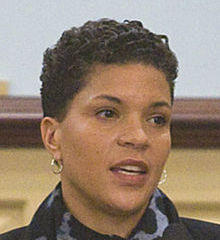
Michelle Alexander
Michelle Alexander

Michelle Alexander is a distinguished professor of law at the University of California, Berkeley. Born on October 7, 1967, she is recognized for her expertise in criminal justice and civil rights. Alexander has authored numerous articles and books on the subject of mass incarceration in the United States and its effects on African American communities. more

You May Also Like

“Faced with an ecological crisis whose roots lie in this disengagement, in the separation of human agency and social responsibility from the sphere of our direct involvement with the non-human environment, it surely behoves us to reverse this order of priority. I began with the point that while both humans and animals have histories of their mutual relations, only humans narrate such histories. But to construct a narrative, one must already dwell in the world and, in the dwelling, enter into relationships with its constituents, both human and non-human. I am suggesting that we rewrite the history of human-animal relations, taking this condition of active engagement, of being-in-the-world, as our starting point. We might speak of it as a history of human concern with animals, insofar as this notion conveys a caring, attentive regard, a 'being with'. And I am suggesting that those of us who are 'with' animals in their day-to-day lives, most notably hunters and herdsmen, can offer us some of the best possible indications of how we might proceed.”

“Cultures the world over consider their staple the incarnation of God: Buffalo for the Cheyenne, Corn for the Hopi, Cattle for the Massai, Wheat (bread) for the Christians. What I've seen about hunting and gathering peoples, they are the only ones who can fully grasp and accept the Holy Communion. (Funny how we think we have to cram our little wafers down their throats.) All life forms are the sacrificial victim—there's absolutely no exception; all are food.”

“We might pity hunter-gatherers for their stuck simplicity, but we would err. They held extensive knowledge, knew deep secrets of their lands and creatures. And they experienced rich and rewarding lives; we know so because when they were threatened, they fought to hold on to them, to the death. Sadly, this remains true as the final tribal peoples get overwhelmed by miners, loggers, ranchers, and planters who value money above humanity, which is perhaps the most salient characteristic of our culture.”

“But, despite the dangers, people continue to take the risk. Children certainly take the risk. Children do what their stomachs tell them to do. They don't think twice when they have to chase a moving train. They run along it, reach for any metal bar at hand, and fling themselves toward whichever half-stable surface they may land on. Children chase after life, even if that chase might end up killing them. Children run and flee. They have an instinct for survival, perhaps, that allows them to endure almost anything just to make it to the other side of horror, whatever may be waiting there for them.”