Quotessence
Home / Authors / Michelle Alexander
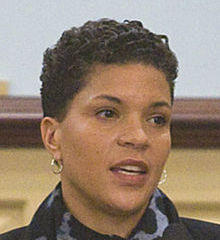
Michelle Alexander

Michelle Alexander Quotes

Professor

Filter quotes by topic

Famous Michelle Alexander Quotes

“Despite claims that these radical policy changes were driven by fiscal conservatism...the reality is that government was not reducing the amount of money devoted to the management of the urban poor. It was radically altering what the funds would be used for....Funding that had once been once used for public housing was being redirected to prison construction.”

“Conversations about class are resisted in part because there is a tendency to imagine that one's class reflects upon one's character. What is key to America's understanding of class is the persistent belief - despite all evidence to the contrary - that anyone, with the proper discipline and drive, can move from a lower class to a higher class. We recognize that mobility may be difficult, but the key to our collective self-image is the assumption that mobility is always possible, so failure to move up reflects on one's character.”

“What is key to America’s understanding of class is the persistent belief — despite all evidence to the contrary — that anyone, with the proper discipline and drive, can move from a lower class to a higher class. We recognize that mobility may be difficult, but the key to our collective self-image is the assumption that mobility is always possible, so failure to move up reflects on one’s character. By extension, the failure of a race or ethnic group to move up reflects very poorly on the group as a whole.”

“There is absolutely nothing surprising about a severely stigmatized group embracing their stigma. Psychologists have long observed that when people feel hopelessly stigmatized, a powerful coping strategy–often the only apparent route to self-esteem–is embracing one's stigmatized identity. Hence, 'black is beautiful' and 'gay pride'–slogans and anthems of the political movements aimed at ending not only legal discrimination, but the stigma that justified it. Indeed, the act of embracing one's stigma is never merely a psychological maneuver; it is a political act–an act of resistance and deviance in a society that seeks to demean a group based on an inalterable trait. As a gay activist once put it, 'Only by fully embracing the stigma itself can one neutralize the sting and make it laughable.”

“The vast majority of states continue to withhold the right to vote when prisoners are released on parole. Even after the term of punishment expires, some states deny the right to vote for a period ranging from a number of years to the rest of one’s life. This is far from the norm in other countries—like Germany, for instance, which allows (and even encourages) prisoners to vote. In fact, about half of European countries allow all incarcerated people to vote, while others disqualify only a small number of prisoners from the polls. Prisoners vote either in their correctional facilities or by some version of absentee ballot in their town of previous residence. Almost all of the countries that place some restrictions on voting in prison are in Eastern Europe, part of the former Communist. No other country in the world disenfranchises people who are released from prison in a manner even remotely resembling the United States. In fact, the United Nations Human Rights Committee has charged that U.S. disenfranchisement policies are discriminatory and violate international law.”

“What is key to America's understanding of class is the persistent belief - despite all evidence to the contrary - that anyone, with the proper discipline and drive, can move from a lower class to a higher class. We recognize the mobility may be difficult, but the key to our collective self-image is the assumption that mobility is always possible, so failure to move up reflects on one's character.”

“At the peak of the Civil Rights Movement, activists and others began to turn their attention to economic problems...The shift in focus served to align the goals of the Civil Rights Movement with key political goals of poor and working-class whites, who were also demanding economic reforms”

“The rhetoric of ‘law and order’ was first mobilized in the late 1950s as Southern governors and law enforcement officials attempted to generate and mobilize white opposition to the Civil Rights Movement. In the years following Brown v. Board of Education, civil rights activists used direct-action tactics in an effort to force reluctant Southern States to desegregate public facilities. Southern governors and law enforcement officials often characterized these tactics as criminal and argued that the rise of the Civil Rights Movement was indicative of a breakdown of law and order. Support of civil rights legislation was derided by Southern conservatives as merely ‘rewarding lawbreakers.’ For more than a decade – from the mid 1950s until the late 1960s – conservatives systematically and strategically linked opposition to civil rights legislation to calls for law and order, arguing that Martin Luther King Jr.’s philosophy of civil disobedience was a leading cause of crime.”

“When we think of racism we think of Governor Wallace of Alabama blocking the schoolhouse door; we think of water hoses, lynchings, racial epithets, and "whites only" signs. These images make it easy to forget that many wonderful, goodhearted white people who were generous to others, respectful of their neighbors, and even kind to their black maids, gardeners, or shoe shiners--and wished them well--nevertheless went to the polls and voted for racial segregation... Our understanding of racism is therefore shaped by the most extreme expressions of individual bigotry, not by the way in which it functions naturally, almost invisibly (and sometimes with genuinely benign intent), when it is embedded in the structure of a social system.”

“Parents and schoolteachers counsel black children that, if they ever hope to escape this system and avoid prison time, they must be on their best behavior, raise their arms and spread their legs for the police without complaint, stay in failing schools, pull up their pants, and refuse all forms of illegal work and moneymaking activity, even if jobs in the legal economy are impossible to find. Girls are told not to have children until they are married to a "good" black man who can help provide for a family with a legal job. They are told to wait and wait for Mr. Right even if that means, in a jobless ghetto, never having children at all.”

“A new civil rights movement cannot be organized around the relics of the earlier system of control if it is to address meaningfully the racial realities of our time. Any racial justice movement, to be successful, must vigorously challenge the public consensus that underlies the prevailing system of control. Nooses, racial slurs, and overt bigotry are widely condemned by people across the political spectrum; they are understood to be remnants of the past, no longer reflective of the prevailing public consensus about race. Challenging these forms of racism is certainly necessary, as we must always remain vigilant, but it will do little to shake the foundations of the current system of control. The new caste system, unlike its predecessors, is officially colorblind. We must deal with it on its own terms.”

“Jim Crow and mass incarceration have similar political origins...both caste systems were born in part, due to desire among white elites to exploit the resentments, vulnerabilities and racial biases of poor and working-class whites for political or economic gain. Segregation laws were proposed as part of a deliberate and strategic effort to deflect anger and hostility that have been brewing against the white elite away from them and toward African Americans. The birth of mass incarceration can be traced to a similar political dynamic. Conservatives in the 1960s and 1970s sought to appeal to the racial biases and economic vulnerabilities of poor and working-class whites through racially coded rhetoric on crime and welfare. In both cases, the racial opportunists offered few, if any, economic reforms to address the legitimate economic anxieties of poor and working-class whites, proposing instead a crackdown on the racially defined "others." In the early years of Jim Crow, conservative white elites competed with each other by passing ever more stringent and oppressive Jim Crow legislation. A century later, politicians in the early years of the drug war competed with each other to prove who could be tougher on crime by passing ever harsher drug laws- a thinly veiled effort to appeal to poor and working-class whites who, once again, proved they were willing to forego economic and structural reform in exchange for an apparent effort to put blacks back "in their place.”

“Because the drug war has been waged almost exclusively in poor communities of color, when drug offenders are released, they are generally returned to racially segregated ghetto communities--the places they call home. In many cities, the re-entry phenomenon is highly concentrated in a small number of neighborhoods. According to one study, during a twelve-year period, the number of prisoners returning home to "core counties"--those counties that contain the inner city of a metropolitan area--tripled. The effects are felt throughout the United States. In interviews with one hundred residents of two Tallahassee, Florida communities, researchers found that nearly every one of them had experienced or expected to experience the return of a family member from prison. Similarly, a survey of families living in the Robert Taylor Homes in Chicago found that the majority of residents either had a family member in prison or expected one to return from prison within the next two years. Fully 70 percent of men between the ages of eighteen and forty-five in the impoverished and overwhelmingly black North Lawndale neighborhood on Chicago's West Side are ex-offenders, saddled for life with a criminal record. The majority (60 percent) were incarcerated for drug offenses. These neighborhoods are a minefield for parolees, for a standard condition of parole is a promise not to associate with felons. As Paula Wolff, a senior executive at Chicago Metropolis 2020 observes, in these ghetto neighborhoods, "It is hard for a parolee to walk to the corner store to get a carton of milk without being subject to a parole violation.”

“By the turn of the twentieth century, every state in the South had laws on the books that disenfranchised blacks and discriminated against them in virtually ever sphere of life, lending sanction to a racial ostracism that extended to schools, churches, housing, jobs, restrooms, hotels, restaurants, hospitals, orphanages, prisons, funeral homes, morgues, and cemeteries. Politicians competed with each other by proposing and passing every more stringent, oppressive, and downright ridiculous legislation (such as laws specifically prohibiting blacks and whites from playing chess together.)”

“In the era of colorblindness, it is no longer socially permissible to use race, explicitly, as a justification for discrimination, exclusion, and social contempt. So we don’t. Rather than rely on race, we use our criminal justice system to label people of color 'criminals' and then engage in all the practices we supposedly left behind.”

“With respect to parole, in 1980, only 1 percent of all prison admissions were parole violators. Twenty years later, more than one third (35 percent) of prison admissions resulted from parole violations. To put the matter more starkly: About as many people were returned to prison for parole violations in 2000 as were admitted to prison in 1980 for all reasons. Of all parole violators returned to prison in 2000, only one-third were returned for a new conviction; two-thirds were returned for a technical violation such as missing appointments with a parole officer, failing to maintain employment, or failing a drug test.”

“The petition argued that the Court's decision was a dire mistake; if the decision were allowed to stand and prosecutors were compelled to explain gross racial disparities such as the ones at issue, it would...'paralyze the criminal justice system'—apparently because severe and inexplicable racial disparities pervaded the system as a whole.”

“The McCleskey decision was not really about the death penalty at all; rather, the Court's opinion was driven by a desire to immunize the entire criminal justice system from claims of racial bias...Racial discrimination, the Court seemed to suggest, was something that simply must be tolerated in the criminal justice system, provided no one admits to racial bias.”

“Segregation laws were proposed as part of a deliberate effort to drive a wedge between poor whites and African Americans. These discriminatory barriers were designed to encourage lower-class whites to retain a sense of superiority over blacks, making it far less likely that they would sustain interracial political alliances aimed at toppling the white elite.”

“The radical philosophy offered, for many African Americans, the most promise. It was predicated on a searing critique of large corporations, particularly railroads, and the wealthy elite in the North and South. The radicals of the late nineteenth century, who later formed the Populist Party, viewed the privileged classes as conspiring to keep poor whites and blacks locked into a subordinate political and economic position. For many African American voters, the Populist approach was preferable to the paternalism of liberals.”

“Yet our ability to exercise free will and transcend the most extraordinary obstacles does not make the conditions of our life irrelevant. Most of us struggle and often fail to meet the biggest challenges of our lives. Even the smaller challenges—breaking a bad habit or sticking to a diet—often prove too difficult, even for those of us who are relatively privileged and comfortable in our daily lives. In fact, what is most remarkable about the hundreds of thousands of people who return from prison to their communities each year is not how many fail, but how many somehow manage to survive and stay out of prison against all odds.”

“In Waquant's words: "Racial division was a consequence, not a precondition of slavery, but once it was instituted it became detached from its initial function and acquired a social potency all its own." After the death of slavery, the idea of race lived on/”

“It my be helpful, in attempting to understand the basic nature of the new caste system, to think of the criminal justice system-the entire collection of institutions and practices that comprise it-not as an independent system but rather as a gateway into a much larger system of racial stigmatization and permanent marginalization. This larger system, referred to here as mass incarceration, is a system that locks people not only behind actual bars in actual prisons, but also behind virtual bars and virtual walls-walls that are invisible to the naked eye but function nearly as effectively as Jim Crow laws once did at locking people of color int a permanent second-class citizenship. The term mass incarceration refers not only to the criminal justice system but also to the web of laws, rules, policies, and customs that control those labeled criminals both in and outside of prison. Once released, former prisoners enter a hidden underworld of legalized discrimination and permanent social exclusion. They are members of America's new undercaste.”

“Vagrancy laws and other laws defining activities such as "mischief" and "insulting gestures" as crimes were enforced vigorously against blacks. The aggressive enforcement of these criminal offenses opened up an enormous market for convict leasing.”

“As Angela Davis has explained, if we accept uncritically the notion that prisons offer an answer, and that all we must do is improve our so-called justice systems, we evade the 'responsibility of seriously engaging with the problems of our society, especially those produced by racism and, increasingly, global capitalism.' Our ultimate goal-if we truly aim to overcome our nation's habit of constructing enormous systems of racial and social control-cannot simply be to reduce the number of people behind bars. We must strive to create a nation in which caging people en masse-digitally or literally-and stripping them of basic civil and human rights for the rest of their lives is not only unnecessary but unthinkable. . . . The important question, however, is whether we want to celebrate as 'progress' any development that might reflect the morphing or evolution of the system, rather than its demise. Human rights champion Bryan Stevenson has observed that 'slavery didn't end; it evolved.' Today, we can see, in real time, the system of mass incarceration evolving before our eyes, as enormous investments are made in immigrant detention centers and digital prisons, and as growing numbers of white people become collateral damage in a war that was declared with black people in mind.”

“The shift may, in fact, come as something of a relief, as it moves our collective focus away from a wholly unrealistic goal to one that is within anyone's reach right now. After all, to aspire to colorblindness is to aspire to a state of being in which you are not capable of seeing racial difference—a practical impossibility for most of us. The shift also invites a more optimistic view of human capacity. The colorblindness ideal is premised on the notion that we, as a society, can never be trusted to see race and treat each other fairly or with genuine compassion. A commitment to color consciousness, by contrast, places faith in our capacity as humans to show care and concern for others, even as we are fully cognizant of race and possible racial differences.”

“The notion that a vast gulf exists between "criminals" and those of us who have never served time in prison is a fiction created by the racial ideology that birthed mass incarceration, namely that there is something fundamentally wrong and morally inferior about "them." The reality, though, is that all of us have done wrong. As noted earlier, studies suggest that most Americans violate drug laws in their lifetime. Indeed, most of us break the law not once but repeatedly throughout our lives. Yet only some of us will be arrested, charged, convicted of a crime, branded a criminal or a felon, and ushered into a permanent undercaste. Who becomes a social pariah and excommunicated from civil society and who trots off to college bears scant relationship to the morality of the crimes committed. Who is more blameworthy: the young black kid who hustles on the street corner, selling weed to help his momma pay rent? Or the college kid who deals drugs out of his dorm room so that he'll have cash to finance his spring break? Who should we fear? The kid in the 'hood who joined a gang and now carries a gun for security, because his neighborhood is frightening and unsafe? Or the suburban high school student who has a drinking problem but keeps getting behind the wheel? Our racially biased system of mass incarceration exploits the fact that all people break the law and make mistakes at various points in their lives with varying degrees of justification. Screwing up-failing to live by one's highest ideals and values-is part of what makes us human.”

“All people make mistakes. All of us are sinners. All of us are criminals. All of us violate the law at some point in our lives. In fact, if the worst thing you have ever done is speed ten miles over the speed limit on the freeway, you have put yourself and others at more risk of harm than someone smoking marijuana in the privacy of his or her living room. Yet there are people in the United States serving life sentences for first-time drug offenses, something virtually unheard of anywhere else in the world.”

“If we want to do more than just end mass incarceration—if we want to put an end to the history of racial caste in America—we must lay down our racial bribes, join hands with people of all colors who are not content to wait for change to trickle down, and say to those who would stand in our way: Accept all of us or none.”

“The War on Drugs, cloaked in race-neutral language, offered whites opposed to racial reform a unique opportunity to express their hostility toward blacks and black progress, without being exposed to the charge of racism.”