Quotessence
Home / Authors / Michelle Alexander
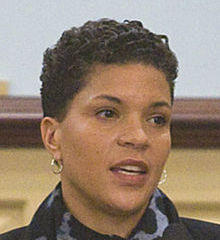
Michelle Alexander

Michelle Alexander Quotes

Professor

Filter quotes by topic

Famous Michelle Alexander Quotes

“Because the drug war has been waged almost exclusively in poor communities of color, when drug offenders are released, they are generally returned to racially segregated ghetto communities--the places they call home. In many cities, the re-entry phenomenon is highly concentrated in a small number of neighborhoods. According to one study, during a twelve-year period, the number of prisoners returning home to "core counties"--those counties that contain the inner city of a metropolitan area--tripled. The effects are felt throughout the United States. In interviews with one hundred residents of two Tallahassee, Florida communities, researchers found that nearly every one of them had experienced or expected to experience the return of a family member from prison. Similarly, a survey of families living in the Robert Taylor Homes in Chicago found that the majority of residents either had a family member in prison or expected one to return from prison within the next two years. Fully 70 percent of men between the ages of eighteen and forty-five in the impoverished and overwhelmingly black North Lawndale neighborhood on Chicago's West Side are ex-offenders, saddled for life with a criminal record. The majority (60 percent) were incarcerated for drug offenses. These neighborhoods are a minefield for parolees, for a standard condition of parole is a promise not to associate with felons. As Paula Wolff, a senior executive at Chicago Metropolis 2020 observes, in these ghetto neighborhoods, "It is hard for a parolee to walk to the corner store to get a carton of milk without being subject to a parole violation.”

“Yet our ability to exercise free will and transcend the most extraordinary obstacles does not make the conditions of our life irrelevant. Most of us struggle and often fail to meet the biggest challenges of our lives. Even the smaller challenges—breaking a bad habit or sticking to a diet—often prove too difficult, even for those of us who are relatively privileged and comfortable in our daily lives. In fact, what is most remarkable about the hundreds of thousands of people who return from prison to their communities each year is not how many fail, but how many somehow manage to survive and stay out of prison against all odds.”

“One in three young African American men is currently under the control of the criminal justice system in prison, in jail, on probation, or on parole - yet mass incarceration tends to be categorized as a criminal justice issue as opposed to a racial justice or civil rights issue (or crisis).”

“Mandatory minimum sentences give no discretion to judges about the amount of time that the person should receive once a guilty verdict is rendered. Harsh mandatory minimum sentences for drug offenses were passed by Congress in the 1980s as part of the war on drugs and the "get tough" movement, sentences that have helped to fuel our nation's prison boom and have also greatly aggravated racial disparities, particularly in the application of mandatory minimum sentences for crack cocaine.”

“For children, the era of mass incarceration has meant a tremendous amount of family separation, broken homes, poverty, and a far, far greater level of hopelessness as they see so many of their loved ones cycling in and out of prison. Children who have incarcerated parents are far more likely themselves to be incarcerated.”

“When young black men reach a certain age - whether or not there is incarceration in their families - they themselves are the target of police stops, interrogations, frisks, often for no reason other than their race. And, of course, this level of harassment sends a message to them, often at an early age: No matter who you are or what you do, you're going to find yourself behind bars one way or the other. This reinforces the sense that prison is part of their destiny, rather than a choice one makes.”

“The mythology around colorblindness leads people to imagine that if poor kids of color are failing or getting locked up in large numbers, it must be something wrong with them. It leads young kids of color to look around and say: "There must be something wrong with me, there must be something wrong with us. Is there something inherent, something different about me, about us as a people, that leads us to fail so often, that leads us to live in these miserable conditions, that leads us to go in and out of prison?"”

“The education justice movement and the prison justice movement have been operating separately in many places as though they're in silos. But the reality is we're not going to provide meaningful education opportunities to poor kids, kids of color, until and unless we recognize that we're wasting trillions of dollars on a failed criminal justice system.”

“Kids are growing up in communities in which they see their loved ones cycling in and out of prison and in which they are sent the message in countless ways that they, too, are going to prison one way or another. We cannot build healthy, functioning schools within a context where there is no funding available because it's going to building prisons and police forces.”

“I think it's critically important for people to understand that this system of mass incarceration governs not just those who find themselves in prison on any given day, but also all those who are in jail, on probation or parole, as well as all those who are just months away from being locked up again because they are unable to find work or housing due to their criminal record.”

“The war on drugs has been the engine of mass incarceration. Drug convictions alone constituted about two-thirds of the increase in the federal prison population and more than half of the increase in the state prison population between 1985 and 2000, the period of our prison system's most dramatic expansion.”

“What are people released from prison expected to do? How are they expected to survive? Can't get a job, locked out of housing, and even food stamps may be off limits. Well, apparently what we expect them to do is to pay hundreds or thousands of dollars in fees, fines, court costs, and back child support (which continues to accrue while you are in prison).”

“In a growing number of states, you're actually expected to pay back the costs of your imprisonment. Paying back all these fees, fines, and costs may be a condition of your probation or parole. To make matters worse, if you're one of the lucky few who actually manages to get a job following release from prison, up to 100% of your wages can be garnished to pay back all those fees, fines and court costs. One hundred percent.”

“We would never throw up our hands and say to those white boys - well, too bad, if you had just stayed away from marijuana or not dealt dope to your friends when you were 18 you wouldn't be serving a life sentence in prison right now. You wouldn't be locked out of jobs, unable to even get work at McDonalds. No, instead we'd say, "What's wrong with us as a nation that we would condemn so many of our young men to a life of poverty, exclusion, and scorn simply because they made a few mistakes in their youth?".”

“The prison-industrial complex employs millions of people directly and indirectly. Judges, prosecutors, defense attorneys, prison guards, construction companies that build prisons, police, probation officers, court clerks, the list goes on and on. Many predominately white rural communities have come to believe that their local economies depend on prisons for jobs.”

“In response to the advocacy of groups like Mothers Against Drunk Driving, most states adopted tougher laws to punish drunk driving. Numerous states now have some type of mandatory sentencing for this offense - typically two days in jail for a first offense and two to ten days for a second offense. Possession of a tiny amount of crack cocaine, on the other hand, was given a mandatory minimum sentence of five years in prison.”

“I think that we need to begin talking about what does it mean to create these safe spaces in our communities, to begin welcoming one another into our homes and into our communities when they're returning home from prison, people who are on the streets. We need to begin doing the work in our own communities of creating the kind of democracy that we would like to see on a larger scale.”

“... as recently as the mid-1970s, the most well-respected criminologists were predicting that the prison system would soon fade away. Prison did not deter crime significantly, many experts concluded. Those who had meaningful economic and social opportunities were unlikely to commit crimes regardless of the penalty, while those who went to prison were far more likely to commit crimes again in the future.”

“The system functioned relatively automatically, and the prevailing system of racial meanings, identities, and ideologies already seemed natural. Ninety percent of those admitted to prison for drug offenses in many states were Black or Latino, yet the mass incarceration of communities of color was explained in race-neutral terms, an adaptation to the needs and demands of the current political climate.”

“The United States imprisons a larger percentage of its black population than South Africa did at the height of apartheid. In Washington, D.C., our nation’s capitol, it is estimated that three out of four young black men (and nearly all those in the poorest neighborhoods) can expect to serve time in prison.”

“Today there are more African-Americans under correctional control, in prison or jail, on probation or parole, than were enslaved in 1850, a decade before the Civil War began. There are millions of African-Americans now cycling in and out of prisons and jails or under correctional control or saddled with criminal records. In major American cities today, more than half of working-age African-American men either are under correctional control or are branded felons, and are thus subject to legalized discrimination for the rest of their lives.”