Quotessence
Home / Authors / Michelle Alexander
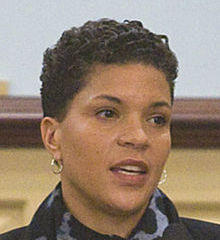
Michelle Alexander

Michelle Alexander Quotes

Professor

Filter quotes by topic

Famous Michelle Alexander Quotes

“All people make mistakes. All of us are sinners. All of us are criminals. All of us violate the law at some point in our lives. In fact, if the worst thing you have ever done is speed ten miles over the speed limit on the freeway, you have put yourself and others at more risk of harm than someone smoking marijuana in the privacy of his or her living room. Yet there are people in the United States serving life sentences for first-time drug offenses, something virtually unheard of anywhere else in the world.”

“If we want to do more than just end mass incarceration—if we want to put an end to the history of racial caste in America—we must lay down our racial bribes, join hands with people of all colors who are not content to wait for change to trickle down, and say to those who would stand in our way: Accept all of us or none.”

“What has changed since the collapse of Jim Crow has less to do with the basic structure of our society than with the language we use to justify it. In the era of colorblindness, it is no longer socially permissible to use race, explicitly, as a justification for discrimination, exclusion, and social contempt. So we don't. Rather than rely on race, we use our criminal justice system to label people of color "criminals" and then engage in all the practices we supposedly left behind.”

“For African American children, in particular, the odds are extremely high that they will have a parent or loved one, a relative, who has either spent time behind bars or who has acquired a criminal record and thus is part of the under-caste - the group of people who can be legally discriminated against for the rest of their lives. For many African American children, their fathers, and increasingly their mothers, are behind bars. It is very difficult for them to visit. Many people are held hundreds or even thousands of miles away from home.”

“The wave of punitiveness that washed over the United States with the rise of the drug war and the get tough movement really flooded our schools. Schools, caught up in this maelstrom, began viewing children as criminals or suspects, rather than as young people with an enormous amount of potential struggling in their own ways and their own difficult context to make it and hopefully thrive. We began viewing the youth in schools as potential violators rather than as children needing our guidance.”

“The mythology around colorblindness leads people to imagine that if poor kids of color are failing or getting locked up in large numbers, it must be something wrong with them. It leads young kids of color to look around and say: "There must be something wrong with me, there must be something wrong with us. Is there something inherent, something different about me, about us as a people, that leads us to fail so often, that leads us to live in these miserable conditions, that leads us to go in and out of prison?"”

“I think this mythology - that we're all beyond race, of course our police officers aren't racist, of course our politicians don't mean any harm to people of color - this idea that we're beyond all that (so it must be something else) makes it difficult for young people as well as the grown-ups to be able to see clearly and honestly the truth of what's going on. It makes it difficult to see that the backlash against the Civil Rights Movement manifested itself in the form of mass incarceration, in the form of defunding and devaluing schools serving kids of color and all the rest.”

“Of course, no one should be trapped in bad schools or bad neighborhoods. No one. But I think we need to be asking a larger question: How do we change the norm, the larger context that people seem to accept as a given? Are we so thoroughly resigned to what "is" that we cannot even begin a serious conversation about how to create what ought to be?”

“We're foolish if we think we're going to end mass incarceration unless we are willing to deal with the reality that huge percentages of poor people are going to remain jobless, locked out of the mainstream economy, unless and until they have a quality education that prepares them well for the new economy. There has got to be much more collaboration between the two movements and a greater appreciation for the work of the advocates in each community. It's got to be a movement that's about education, not incarceration - about jobs, not jails.”

“It's important to teach students about the reality of the system, that it is in fact the case that they are being targeted unfairly, that the rules have been set up in a way that authorize unfair treatment of them, and how difficult it is to challenge these laws in the courts. We need to teach them how our politics have changed in recent years, how there has been, in fact, a backlash. But we need to couple that information with stories of how people in the past have challenged these kinds of injustices, and the role that youth have played historically in those struggles.”

“I think it's important to encourage young people to tell their own stories and to speak openly about their own experiences with the criminal justice system and the experiences of their family. We need to ensure that the classroom environment is a supportive one so that the shame and stigma can be dispelled.”

“Just providing information about how bad things are, or the statistics and data on incarceration by themselves, does lead to more depression and resignation and is not empowering. The information has to be presented in a way that's linked to the piece about encouraging students to think critically and creatively about how they might respond to injustice, and how young people have responded to injustice in the past.”

“I think it's critically important for people to understand that this system of mass incarceration governs not just those who find themselves in prison on any given day, but also all those who are in jail, on probation or parole, as well as all those who are just months away from being locked up again because they are unable to find work or housing due to their criminal record.”

“Most Americans violate drug laws in their lifetime, but the enemy in this war has been racially defined. Not by accident, the drug war has been waged almost exclusively in poor communities of color, even though studies have consistently shown - for decades - the people of color are no more likely to use or sell illegal drugs than whites.”

“For the rest of your life you must check the box on employment applications asking the dreaded question: "Have you ever been convicted of a felony?" And once you check that box, the odds are sky high that your application is going straight to the trash. Hundreds of professional licenses are off-limits to people convicted of felonies.”

“What are people released from prison expected to do? How are they expected to survive? Can't get a job, locked out of housing, and even food stamps may be off limits. Well, apparently what we expect them to do is to pay hundreds or thousands of dollars in fees, fines, court costs, and back child support (which continues to accrue while you are in prison).”

“Many people don't realize that financial incentives have been built into the drug war that guarantee that law enforcement will continue to arrest extraordinary numbers of people, particularly in poor communities of color, for minor drug offenses that get ignored on the other side of town.”

“Of course in this age of colorblindness, a time when we have supposedly moved "beyond race," we as a nation would feel very uncomfortable if only black people were sent to jail for drug offenses. We seem comfortable with 90 percent of the people arrested and convicted of drug offenses in some states being African American, but if the figure was 100 percent, the veil of colorblindness would be lost.”

“The prison-industrial complex employs millions of people directly and indirectly. Judges, prosecutors, defense attorneys, prison guards, construction companies that build prisons, police, probation officers, court clerks, the list goes on and on. Many predominately white rural communities have come to believe that their local economies depend on prisons for jobs.”

“My own view - and I'm very open to hearing other perspectives - is that this movement-building needs to begin at home, in local communities. It isn't about trying to launch a brand new national party overnight. It's about people in communities coming together across lines of difference, bringing with them their movements, their families, and coming together and saying, "How can we together build a movement of movements here at home? What would that look like? What do we want to do right here in our communities?"”

“I think that we need to begin talking about what does it mean to create these safe spaces in our communities, to begin welcoming one another into our homes and into our communities when they're returning home from prison, people who are on the streets. We need to begin doing the work in our own communities of creating the kind of democracy that we would like to see on a larger scale.”

“The so-called resistance is very broad and we don't agree on everything, but there's a moment of opportunity when people are paying attention. It's time for us to really get serious about political education and about our own moral education in this moment, and to seize this opportunity to organize and be in deep dialogue with a whole lot of people who never even thought about being politically engaged or active before. There's real hope there and real opportunity.”

“We can't just assume that this resistance is going to produce the kinds of candidates or the kinds of parties that will truly honor people of all colors, all backgrounds, all ethnicities, from every nation and every faith and every gender, unless we do the work in our own communities of organizing and being in deep dialogue with one another across all forms of difference. It's my hope that we'll seize this opportunity and not let the moment pass.”

“The fate of millions of people—indeed the future of the black community itself—may depend on the willingness of those who care about racial justice to re-examine their basic assumptions about the role of the criminal justice system in our society.”

“More than 2 million people found themselves behind bars at the turn of the twenty-first century, and millions more were relegated to the margins of mainstream society, banished to a political and social space not unlike Jim Crow, where discrimination in employment, housing, and access to education was perfectly legal, and where they could be denied the right to vote.”

“Arguably the most important parallel between mass incarceration and Jim Crow is that both have served to define the meaning and significance of race in America. Indeed, a primary function of any racial caste system is to define the meaning of race in its time. Slavery defined what it meant to be black (a slave), and Jim Crow defined what it meant to be black (a second-class citizen). Today mass incarceration defines the meaning of blackness in America: black people, especially black men, are criminals. That is what it means to be black.”