Quotessence
Home / Authors / Michelle Alexander
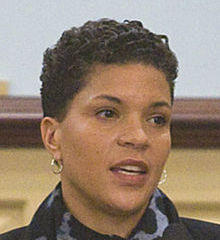
Michelle Alexander

Michelle Alexander Quotes

Professor

Filter quotes by topic

Famous Michelle Alexander Quotes

“One in three young African American men is currently under the control of the criminal justice system in prison, in jail, on probation, or on parole - yet mass incarceration tends to be categorized as a criminal justice issue as opposed to a racial justice or civil rights issue (or crisis).”

“Eventually [black men] are arrested, whether they've committed any serious crime or not, and branded criminals or felons for life. Upon release, they're ushered into a parallel social universe in which the civil and human rights supposedly won during the Civil Rights Movement no longer apply to them.”

“For the rest of their lives, [black men] can be denied the right to vote, automatically excluded from juries, and legally discriminated against in employment, housing, access to education and public benefits. So many of the old forms of discrimination that we supposedly left behind during the Jim Crow era are suddenly legal again once you've been branded a felon.”

“When young black men reach a certain age - whether or not there is incarceration in their families - they themselves are the target of police stops, interrogations, frisks, often for no reason other than their race. And, of course, this level of harassment sends a message to them, often at an early age: No matter who you are or what you do, you're going to find yourself behind bars one way or the other. This reinforces the sense that prison is part of their destiny, rather than a choice one makes.”

“For those who say that the war on drugs and the system of mass incarceration really isn't about race, I say there is no way we would allow the majority of young white men to be swept into the criminal justice system for minor drug offenses, branded criminals and felons, and then stripped of their basis civil and human rights while young black men who are engaged in the same activity trot off to college. That would never be accepted as the norm.”

“We would never throw up our hands and say to those white boys - well, too bad, if you had just stayed away from marijuana or not dealt dope to your friends when you were 18 you wouldn't be serving a life sentence in prison right now. You wouldn't be locked out of jobs, unable to even get work at McDonalds. No, instead we'd say, "What's wrong with us as a nation that we would condemn so many of our young men to a life of poverty, exclusion, and scorn simply because they made a few mistakes in their youth?".”

“Arguably the most important parallel between mass incarceration and Jim Crow is that both have served to define the meaning and significance of race in America. Indeed, a primary function of any racial caste system is to define the meaning of race in its time. Slavery defined what it meant to be black (a slave), and Jim Crow defined what it meant to be black (a second-class citizen). Today mass incarceration defines the meaning of blackness in America: black people, especially black men, are criminals. That is what it means to be black.”

“The United States imprisons a larger percentage of its black population than South Africa did at the height of apartheid. In Washington, D.C., our nation’s capitol, it is estimated that three out of four young black men (and nearly all those in the poorest neighborhoods) can expect to serve time in prison.”

“Today there are more African-Americans under correctional control, in prison or jail, on probation or parole, than were enslaved in 1850, a decade before the Civil War began. There are millions of African-Americans now cycling in and out of prisons and jails or under correctional control or saddled with criminal records. In major American cities today, more than half of working-age African-American men either are under correctional control or are branded felons, and are thus subject to legalized discrimination for the rest of their lives.”

“The fact that more than half of the young black men in any large American city are currently under the control of the criminal justice system (or saddled with criminal records) is not - as many argue - just a symptom of poverty or poor choices, but rather evidence of a new racial caste system at work.”

“Once you're labeled a felon, the old forms of discrimination - employment discrimination, housing discrimination, denial of the right to vote, denial of educational opportunity, denial of food stamps and other public benefits, and exclusion from jury service - are suddenly legal. As a criminal, you have scarcely more rights, and largely less respect, than a black man living in Alabama at the height of Jim Crow. We have not ended racial caste in America; we have merely redesigned it.”