Quotessence
Home / Authors / Michelle Alexander
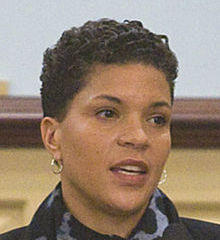
Michelle Alexander

Michelle Alexander Quotes

Professor

Filter quotes by topic

Famous Michelle Alexander Quotes

“Despite claims that these radical policy changes were driven by fiscal conservatism...the reality is that government was not reducing the amount of money devoted to the management of the urban poor. It was radically altering what the funds would be used for....Funding that had once been once used for public housing was being redirected to prison construction.”

“There is absolutely nothing surprising about a severely stigmatized group embracing their stigma. Psychologists have long observed that when people feel hopelessly stigmatized, a powerful coping strategy–often the only apparent route to self-esteem–is embracing one's stigmatized identity. Hence, 'black is beautiful' and 'gay pride'–slogans and anthems of the political movements aimed at ending not only legal discrimination, but the stigma that justified it. Indeed, the act of embracing one's stigma is never merely a psychological maneuver; it is a political act–an act of resistance and deviance in a society that seeks to demean a group based on an inalterable trait. As a gay activist once put it, 'Only by fully embracing the stigma itself can one neutralize the sting and make it laughable.”

“Jim Crow and mass incarceration have similar political origins...both caste systems were born in part, due to desire among white elites to exploit the resentments, vulnerabilities and racial biases of poor and working-class whites for political or economic gain. Segregation laws were proposed as part of a deliberate and strategic effort to deflect anger and hostility that have been brewing against the white elite away from them and toward African Americans. The birth of mass incarceration can be traced to a similar political dynamic. Conservatives in the 1960s and 1970s sought to appeal to the racial biases and economic vulnerabilities of poor and working-class whites through racially coded rhetoric on crime and welfare. In both cases, the racial opportunists offered few, if any, economic reforms to address the legitimate economic anxieties of poor and working-class whites, proposing instead a crackdown on the racially defined "others." In the early years of Jim Crow, conservative white elites competed with each other by passing ever more stringent and oppressive Jim Crow legislation. A century later, politicians in the early years of the drug war competed with each other to prove who could be tougher on crime by passing ever harsher drug laws- a thinly veiled effort to appeal to poor and working-class whites who, once again, proved they were willing to forego economic and structural reform in exchange for an apparent effort to put blacks back "in their place.”

“Because the drug war has been waged almost exclusively in poor communities of color, when drug offenders are released, they are generally returned to racially segregated ghetto communities--the places they call home. In many cities, the re-entry phenomenon is highly concentrated in a small number of neighborhoods. According to one study, during a twelve-year period, the number of prisoners returning home to "core counties"--those counties that contain the inner city of a metropolitan area--tripled. The effects are felt throughout the United States. In interviews with one hundred residents of two Tallahassee, Florida communities, researchers found that nearly every one of them had experienced or expected to experience the return of a family member from prison. Similarly, a survey of families living in the Robert Taylor Homes in Chicago found that the majority of residents either had a family member in prison or expected one to return from prison within the next two years. Fully 70 percent of men between the ages of eighteen and forty-five in the impoverished and overwhelmingly black North Lawndale neighborhood on Chicago's West Side are ex-offenders, saddled for life with a criminal record. The majority (60 percent) were incarcerated for drug offenses. These neighborhoods are a minefield for parolees, for a standard condition of parole is a promise not to associate with felons. As Paula Wolff, a senior executive at Chicago Metropolis 2020 observes, in these ghetto neighborhoods, "It is hard for a parolee to walk to the corner store to get a carton of milk without being subject to a parole violation.”

“With respect to parole, in 1980, only 1 percent of all prison admissions were parole violators. Twenty years later, more than one third (35 percent) of prison admissions resulted from parole violations. To put the matter more starkly: About as many people were returned to prison for parole violations in 2000 as were admitted to prison in 1980 for all reasons. Of all parole violators returned to prison in 2000, only one-third were returned for a new conviction; two-thirds were returned for a technical violation such as missing appointments with a parole officer, failing to maintain employment, or failing a drug test.”

“It my be helpful, in attempting to understand the basic nature of the new caste system, to think of the criminal justice system-the entire collection of institutions and practices that comprise it-not as an independent system but rather as a gateway into a much larger system of racial stigmatization and permanent marginalization. This larger system, referred to here as mass incarceration, is a system that locks people not only behind actual bars in actual prisons, but also behind virtual bars and virtual walls-walls that are invisible to the naked eye but function nearly as effectively as Jim Crow laws once did at locking people of color int a permanent second-class citizenship. The term mass incarceration refers not only to the criminal justice system but also to the web of laws, rules, policies, and customs that control those labeled criminals both in and outside of prison. Once released, former prisoners enter a hidden underworld of legalized discrimination and permanent social exclusion. They are members of America's new undercaste.”

“If we want to do more than just end mass incarceration—if we want to put an end to the history of racial caste in America—we must lay down our racial bribes, join hands with people of all colors who are not content to wait for change to trickle down, and say to those who would stand in our way: Accept all of us or none.”

“One in three young African American men is currently under the control of the criminal justice system in prison, in jail, on probation, or on parole - yet mass incarceration tends to be categorized as a criminal justice issue as opposed to a racial justice or civil rights issue (or crisis).”

“For children, the era of mass incarceration has meant a tremendous amount of family separation, broken homes, poverty, and a far, far greater level of hopelessness as they see so many of their loved ones cycling in and out of prison. Children who have incarcerated parents are far more likely themselves to be incarcerated.”

“Middle-class white children, children of privilege, are afforded the opportunity to make a lot of mistakes and still go on to college, still dream big dreams. But for kids who are born in the ghetto in the era of mass incarceration, the system is designed in such a way that it traps them, often for life.”

“I think this mythology - that we're all beyond race, of course our police officers aren't racist, of course our politicians don't mean any harm to people of color - this idea that we're beyond all that (so it must be something else) makes it difficult for young people as well as the grown-ups to be able to see clearly and honestly the truth of what's going on. It makes it difficult to see that the backlash against the Civil Rights Movement manifested itself in the form of mass incarceration, in the form of defunding and devaluing schools serving kids of color and all the rest.”

“We're foolish if we think we're going to end mass incarceration unless we are willing to deal with the reality that huge percentages of poor people are going to remain jobless, locked out of the mainstream economy, unless and until they have a quality education that prepares them well for the new economy. There has got to be much more collaboration between the two movements and a greater appreciation for the work of the advocates in each community. It's got to be a movement that's about education, not incarceration - about jobs, not jails.”

“There is a tremendous amount of confusion and denial that exists about mass incarceration today, and that is the biggest barrier to movement building. As long as we remain in denial about this system, movement building will be impossible. Exposing youth in classrooms to the truth about this system and developing their critical capacities will, I believe, open the door to meaningful engagement and collective, inspired action.”

“I think it's critically important for people to understand that this system of mass incarceration governs not just those who find themselves in prison on any given day, but also all those who are in jail, on probation or parole, as well as all those who are just months away from being locked up again because they are unable to find work or housing due to their criminal record.”

“The war on drugs has been the engine of mass incarceration. Drug convictions alone constituted about two-thirds of the increase in the federal prison population and more than half of the increase in the state prison population between 1985 and 2000, the period of our prison system's most dramatic expansion.”

“For those who say that the war on drugs and the system of mass incarceration really isn't about race, I say there is no way we would allow the majority of young white men to be swept into the criminal justice system for minor drug offenses, branded criminals and felons, and then stripped of their basis civil and human rights while young black men who are engaged in the same activity trot off to college. That would never be accepted as the norm.”

“The system functioned relatively automatically, and the prevailing system of racial meanings, identities, and ideologies already seemed natural. Ninety percent of those admitted to prison for drug offenses in many states were Black or Latino, yet the mass incarceration of communities of color was explained in race-neutral terms, an adaptation to the needs and demands of the current political climate.”

“Arguably the most important parallel between mass incarceration and Jim Crow is that both have served to define the meaning and significance of race in America. Indeed, a primary function of any racial caste system is to define the meaning of race in its time. Slavery defined what it meant to be black (a slave), and Jim Crow defined what it meant to be black (a second-class citizen). Today mass incarceration defines the meaning of blackness in America: black people, especially black men, are criminals. That is what it means to be black.”

“Like Jim Crow (and slavery), mass incarceration operates as a tightly networked system of laws, policies, customs, and institutions that operate collectively to ensure the subordinate status of a group defined largely by race.”

“The United States imprisons a larger percentage of its black population than South Africa did at the height of apartheid. In Washington, D.C., our nation’s capitol, it is estimated that three out of four young black men (and nearly all those in the poorest neighborhoods) can expect to serve time in prison.”

“If we continue to tell ourselves the popular myths about racial progress or, worse yet, if we say to ourselves that the problem of mass incarceration is just too big, too daunting for us to do anything about and that we should instead direct our energies to battles that might be more easily won, history will judge us harshly. A human rights nightmare is occurring on our watch.”

“Once you're labeled a felon, the old forms of discrimination - employment discrimination, housing discrimination, denial of the right to vote, denial of educational opportunity, denial of food stamps and other public benefits, and exclusion from jury service - are suddenly legal. As a criminal, you have scarcely more rights, and largely less respect, than a black man living in Alabama at the height of Jim Crow. We have not ended racial caste in America; we have merely redesigned it.”