Quotessence
Home / Authors / Michelle Alexander
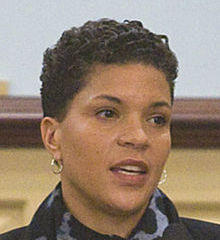
Michelle Alexander

Michelle Alexander Quotes

Professor

Filter quotes by topic

Famous Michelle Alexander Quotes

“If we want to do more than just end mass incarceration—if we want to put an end to the history of racial caste in America—we must lay down our racial bribes, join hands with people of all colors who are not content to wait for change to trickle down, and say to those who would stand in our way: Accept all of us or none.”

“One in three young African American men is currently under the control of the criminal justice system in prison, in jail, on probation, or on parole - yet mass incarceration tends to be categorized as a criminal justice issue as opposed to a racial justice or civil rights issue (or crisis).”

“For children, the era of mass incarceration has meant a tremendous amount of family separation, broken homes, poverty, and a far, far greater level of hopelessness as they see so many of their loved ones cycling in and out of prison. Children who have incarcerated parents are far more likely themselves to be incarcerated.”

“Middle-class white children, children of privilege, are afforded the opportunity to make a lot of mistakes and still go on to college, still dream big dreams. But for kids who are born in the ghetto in the era of mass incarceration, the system is designed in such a way that it traps them, often for life.”

“I think this mythology - that we're all beyond race, of course our police officers aren't racist, of course our politicians don't mean any harm to people of color - this idea that we're beyond all that (so it must be something else) makes it difficult for young people as well as the grown-ups to be able to see clearly and honestly the truth of what's going on. It makes it difficult to see that the backlash against the Civil Rights Movement manifested itself in the form of mass incarceration, in the form of defunding and devaluing schools serving kids of color and all the rest.”

“We're foolish if we think we're going to end mass incarceration unless we are willing to deal with the reality that huge percentages of poor people are going to remain jobless, locked out of the mainstream economy, unless and until they have a quality education that prepares them well for the new economy. There has got to be much more collaboration between the two movements and a greater appreciation for the work of the advocates in each community. It's got to be a movement that's about education, not incarceration - about jobs, not jails.”

“There is a tremendous amount of confusion and denial that exists about mass incarceration today, and that is the biggest barrier to movement building. As long as we remain in denial about this system, movement building will be impossible. Exposing youth in classrooms to the truth about this system and developing their critical capacities will, I believe, open the door to meaningful engagement and collective, inspired action.”

“I think it's critically important for people to understand that this system of mass incarceration governs not just those who find themselves in prison on any given day, but also all those who are in jail, on probation or parole, as well as all those who are just months away from being locked up again because they are unable to find work or housing due to their criminal record.”

“The war on drugs has been the engine of mass incarceration. Drug convictions alone constituted about two-thirds of the increase in the federal prison population and more than half of the increase in the state prison population between 1985 and 2000, the period of our prison system's most dramatic expansion.”

“For those who say that the war on drugs and the system of mass incarceration really isn't about race, I say there is no way we would allow the majority of young white men to be swept into the criminal justice system for minor drug offenses, branded criminals and felons, and then stripped of their basis civil and human rights while young black men who are engaged in the same activity trot off to college. That would never be accepted as the norm.”

“The system functioned relatively automatically, and the prevailing system of racial meanings, identities, and ideologies already seemed natural. Ninety percent of those admitted to prison for drug offenses in many states were Black or Latino, yet the mass incarceration of communities of color was explained in race-neutral terms, an adaptation to the needs and demands of the current political climate.”

“Arguably the most important parallel between mass incarceration and Jim Crow is that both have served to define the meaning and significance of race in America. Indeed, a primary function of any racial caste system is to define the meaning of race in its time. Slavery defined what it meant to be black (a slave), and Jim Crow defined what it meant to be black (a second-class citizen). Today mass incarceration defines the meaning of blackness in America: black people, especially black men, are criminals. That is what it means to be black.”

“Like Jim Crow (and slavery), mass incarceration operates as a tightly networked system of laws, policies, customs, and institutions that operate collectively to ensure the subordinate status of a group defined largely by race.”

“If we continue to tell ourselves the popular myths about racial progress or, worse yet, if we say to ourselves that the problem of mass incarceration is just too big, too daunting for us to do anything about and that we should instead direct our energies to battles that might be more easily won, history will judge us harshly. A human rights nightmare is occurring on our watch.”