Quotessence
Home / Authors / Michelle Alexander
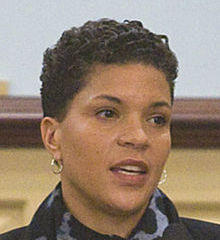
Michelle Alexander

Michelle Alexander Quotes

Professor

Filter quotes by topic

Famous Michelle Alexander Quotes

“All people make mistakes. All of us are sinners. All of us are criminals. All of us violate the law at some point in our lives. In fact, if the worst thing you have ever done is speed ten miles over the speed limit on the freeway, you have put yourself and others at more risk of harm than someone smoking marijuana in the privacy of his or her living room. Yet there are people in the United States serving life sentences for first-time drug offenses, something virtually unheard of anywhere else in the world.”

“The United States does have the highest rate of incarceration in the world dwarfing the rates of even highly repressive regimes like Russia, China or Iran. This reflects a radical shift in criminal justice policy, a stunning development that virtually no one - not even the best criminologists - predicted forty years ago.”

“The wave of punitiveness that washed over the United States with the rise of the drug war and the get tough movement really flooded our schools. Schools, caught up in this maelstrom, began viewing children as criminals or suspects, rather than as young people with an enormous amount of potential struggling in their own ways and their own difficult context to make it and hopefully thrive. We began viewing the youth in schools as potential violators rather than as children needing our guidance.”

“The war on drugs has been the engine of mass incarceration. Drug convictions alone constituted about two-thirds of the increase in the federal prison population and more than half of the increase in the state prison population between 1985 and 2000, the period of our prison system's most dramatic expansion.”

“In a growing number of states, you're actually expected to pay back the costs of your imprisonment. Paying back all these fees, fines, and costs may be a condition of your probation or parole. To make matters worse, if you're one of the lucky few who actually manages to get a job following release from prison, up to 100% of your wages can be garnished to pay back all those fees, fines and court costs. One hundred percent.”

“To make matters worse, federal drug forfeiture laws allow state and local law enforcement agencies to keep, for their own use, up to 80 percent of the cash, cars, and homes seized from suspected drug offenders. You don't even have to be convicted of a drug offense; if you're just suspected of a drug offense, law enforcement has the right to keep the cash they find on you or in your home, or seize your car if drugs are allegedly found in it or "suspected" of being transported in the vehicle.”

“Of course in this age of colorblindness, a time when we have supposedly moved "beyond race," we as a nation would feel very uncomfortable if only black people were sent to jail for drug offenses. We seem comfortable with 90 percent of the people arrested and convicted of drug offenses in some states being African American, but if the figure was 100 percent, the veil of colorblindness would be lost.”

“In response to the advocacy of groups like Mothers Against Drunk Driving, most states adopted tougher laws to punish drunk driving. Numerous states now have some type of mandatory sentencing for this offense - typically two days in jail for a first offense and two to ten days for a second offense. Possession of a tiny amount of crack cocaine, on the other hand, was given a mandatory minimum sentence of five years in prison.”

“The system functioned relatively automatically, and the prevailing system of racial meanings, identities, and ideologies already seemed natural. Ninety percent of those admitted to prison for drug offenses in many states were Black or Latino, yet the mass incarceration of communities of color was explained in race-neutral terms, an adaptation to the needs and demands of the current political climate.”

“The United States imprisons a larger percentage of its black population than South Africa did at the height of apartheid. In Washington, D.C., our nation’s capitol, it is estimated that three out of four young black men (and nearly all those in the poorest neighborhoods) can expect to serve time in prison.”

“No other country in the world imprisons so many of its racial or ethnic minorities. The United States imprisons a larger percentage of its black population than South Africa did at the height of apartheid”