Quotessence
Home / Quotes / Quote by Herman Melville

Quote by Herman Melville

“See ye not then, shipmates, that Jonah sought to flee world-wide from God? Miserable man! Oh! Most contemptible and worthy of all scorn; with slouched hat and guilty eye, skulking from his God; prowling among the shipping like a vile burglar hastening to cross the seas. So disordered, self-condemning is his look, that had there been policemen in those days, Jonah, on the mere suspicion of something wrong, had been arrested ere he touched a deck.”

Quote by Herman Melville

Work

Moby Dick

Moby Dick is a profound and complex novel that explores themes of obsession, fate, and the human condition. The story is narrated by Ishmael, a young man who signs on as a crew member of the Pequod, a whaling ship captained by the obsessed Ahab. The journey is fraught with danger and moral dilemmas, as the crew faces the perils of the sea and the relentless pursuit of their nemesis. The novel is renowned for its vivid descriptions of the ocean and its creatures, as well as its philosophical and existential musings. more
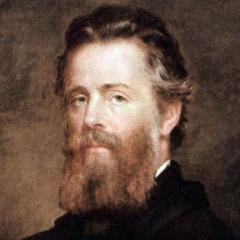
Author

Herman Melville
Herman Melville

Herman Melville was a renowned 19th-century American novelist known for his profound psychological descriptions and unique literary style. His masterpiece, 'Moby-Dick', is considered a classic of American literature. more

You May Also Like

“When the management iceberg is shaped like a huge phallus, you know that there are a lot of tossers that the top penguin has had to climb over to reach the tip and that there is no shortage of the same caliber of penguin in the balls and shaft of the corporation, just waiting for their chance to get a spurt to the top. Should I sugar coat this a little more? or tell it like it is?”

“When two or three people come together in the name of Neverland then I will be there amidst them or if I am too busy or have a better offer, then I will send a proxy or you can just have the tantrum without me, whatever.” (King James Version: Gospel of St. Peter (of Pan)Verse: Blah Paragraph: Blah, blah”

“But . . . but was evil an entity at all? What caused evil? Imperfection in activity . . . imperfection of matter. It could not stand alone. It could not exist by itself. It had to use a pre-existing Good. It was an imperfection of the Good, a privation of the Good, a perversion of the Good. By itself? By itself . . . it was . . . nothing. By itself it had no being. It was *not* an entity. . . . Calmly Thomas began to dictate to Briancourt a sequence of thoughts which tore Evil from its throne of being an entity, a principle in its own right, and relegated it to the status of a parasite.”

“Part of the problem with Dawkins’s criticisms of Aquinas, then (and of the other New Atheists’ criticisms of certain other religious arguments), is that they fail to understand the difference between a scientific hypothesis and an attempted metaphysical demonstration, and illegitimately judge the latter as if it were the former. Of course, they might respond by claiming that scientific reasoning, and maybe mathematical reasoning too, are the only legitimate kinds, and seek thereby to rule out metaphysical arguments from the get go. But there are two problems with this view (which is known as “scientism” or “positivism”). First, if they want to take this position, they’ll need to defend it and not simply assert it; otherwise they’ll be begging the question against their opponents and indulging in just the sort of dogmatism they claim to oppose. Second, the moment they attempt to defend it, they will have effectively refuted it, for scientism or positivism is itself a metaphysical position that could only be justified using metaphysical arguments.”