Quotessence
Home / Quotes / Quote by Emma Goldman

Quote by Emma Goldman

“So long as tyranny exists, in whatever form, man's deepest aspiration must resist it as inevitably as man must breathe.”

Quote by Emma Goldman

Author
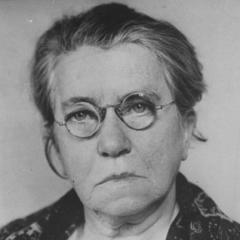
Emma Goldman
Emma Goldman

Emma Goldman was a prominent American writer, lecturer, and activist, known for her work in anarchism and feminism. Born on June 27, 1869, in Lithuania, she immigrated to the United States in her teens. Goldman's life was marked by her advocacy for workers' rights, free speech, and sexual liberation. She was a key figure in the American labor movement and the early 20th-century radical movement. Her influential writings and speaking engagements made her a leading voice in the fight for social and political change. She passed away on May 14, 1940. more

You May Also Like

“Justice requires not only the ceasing and desisting of injustice but also requires either punishment or reparation for injuries and damages inflicted for prior wrongdoing. The essence of justice is the redistribution of gains earned through the perpetration of injustice. If restitution is not made and reparations not instituted to compensate for prior injustices, those injustices are in effect rewarded. And the benefits such rewards conferred on the perpetrators of injustice will continue to "draw interest," to be reinvested, and to be passed on to their children, who will use their inherited advantages to continue to exploit the children of the victims of the injustices of their ancestors. Consequently, injustice and inequality will be maintained across the generations as will their deleterious social, economic, and political outcomes.”

“Morals do exist outside of organized religion, and the ‘morality’ taught by many of these archaic systems is often outdated, sexist, racist, and teaches intolerance and inequality. When a parent forces a child into a religion, the parent is effectively handicapping his or her own offspring by limiting the abilities of the child to question the world around him or her and make informed decisions. Children raised under these conditions will mature believing that their religion is the only correct one, and, in the case of Christianity, they will believe that all who doubt their religion’s validity will suffer eternal damnation. This environment is one that often breeds hate, ignorance, and ‘justified’ violence.”

“Our democratic societies rest on a meritocratic worldview, or at any rate a meritocratic hope, by which I mean a belief in a society in which inequality is based more on merit and effort than on kinship and rents. This belief and this hope play a very crucial role in modern society, for a simple reason: in a democracy, the professed equality of rights of all citizens contrasts sharply with the very real inequality of living conditions, and in order to overcome this contradiction it is vital to make sure that social inequalities derive from rational and universal principles rather than arbitrary contingencies. Inequalities must therefore be just and useful to all, at least in the realm of discourse and as far as possible in reality as well.”

“Freedom is essentially a condition of inequality, not equality. It recognizes as a fact of nature the structural differences inherent in man — in temperament, character, and capacity — and it respects those differences. We are not alike and no law can make us so. Parenthetically, what a stale and uninteresting world this would be if perfect equality prevailed! When you seek the taproot of reform movements, you find an urgency to eradicate these innate differences and to make all men equal; in practice, this means the leveling-off of the more capable to the mediocrity of the average. That is not Freedom.”