Quotessence
Home / Quotes / Quote by Elizabeth Marie Pope

Quote by Elizabeth Marie Pope

“She had often heard her father quote that proverb; he said it was invented by fools to save them the trouble of thinking. " 'Don't meddle in what you can't mend!' " he would growl at her. "And how do you know it's past mending? There'll be time enough not to meddle after you've looked into the matter. At least you could try to satisfy your mind first.”

Quote by Elizabeth Marie Pope

Work

The Perilous Gard

This book is a historical fantasy set in the 14th century, featuring a young woman's journey into a mysterious and enchanted garden. The narrative delves into the complexities of magic, love, and the struggle between good and evil. more

Author

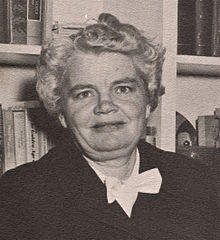
Elizabeth Marie Pope

Elizabeth Marie Pope was a renowned American science fiction author, born on May 1, 1917, and passed away on August 4, 1992. Her works are known for their profound scientific philosophy and rich imagination, having a significant impact on the science fiction genre. more

You May Also Like

“1. The world is everything that is the case. 2. What is the case (a fact) is the existence of states of affairs. 3. A logical picture of facts is a thought. 4. A thought is a proposition with a sense. 5. A proposition is a truth-function of elementary propositions. (An elementary proposition is a truth-function of itself.) 6. The general form of a proposition is the general form of a truth function, which is: [p, E, N(E)]. This is the general form of a proposition. 7. Whereof one cannot speak, thereof one must be silent.”

“6.1 The propositions of logic are tautologies. 6.2 Mathematics is a logical method. The propositions of mathematics are equations, and therefore pseudo-propositions. 6.3 The exploration of logic means the exploration of everything that is subject to law. And outside logic everything is accidental. 6.4 All propositions are of equal value. 6.5 When the answer cannot be put into words, neither can the question be put into words. The riddle does not exist. If a question can be framed at all, it is also possible to answer it.”

“I believed love was all you need. I believed you should be here now. I believed drugs could make everyone a better person. I believed I could hitchhike to California with 35 cents and people would be glad to feed me. I believed Mao was cute. I believed private property was wrong. I believed my girlfriend was a witch. I believed my parents were Nazi space monsters. I believed the university was putting saltpeter in the cafeteria food. I believed stones had souls. I believed the NLF were the good guys in Vietnam. I believed Lyndon Johnson was plotting to murder all the Negroes. I believed Yoko Ono was an artist. I believed Bob Dylan was a musician. I believed I would live forever or until I was 21, whichever came first. I believed the world was coming to an end. I believed the Age of Aquarius was about to begin. I believed the I Ching said to cut classes and take over the Dean's office. I believed wearing my hair long would end poverty and injustice. I believed there was a great throbbing web of cosmic mucus and we were all part of it somehow. I managed to believe Gandhi and H. Rap Brown at the same time. With the exception of anything my mom and dad said, I believed everything.”

“God and religion before every thing!' Dante cried. 'God and religion before the world.' Mr Casey raised his clenched fist and brought it down on the table with a crash. 'Very well then,' he shouted hoarsely, 'if it comes to that, no God for Ireland!' 'John! John!' cried Mr Dedalus, seizing his guest by the coat sleeve. Dante stared across the table, her cheeks shaking. Mr Casey struggled up from his chair and bent across the table towards her, scraping the air from before his eyes with one hand as though he were tearing aside a cobweb. 'No God for Ireland!' he cried, 'We have had too much God in Ireland. Away with God!”

“Logical reasoning leads to scientific knowledge, but it can also lead to wisdom — and not only by clarifying first principles and overthrowing false assumptions, but also by perceiving the patterns in our personalities, in the covert qualities of our desires, in the inescapable continuum of our free wills’ pursuit of happiness and even in our supposedly irrational emotions, clearly revealing the beauty of life’s inherent rules and effectively eliminating the illusions we have ironically been relying upon to give us hope in the absence of a more profound perspective.”