Quotessence
Home / Quotes / Quote by Leo Tolstoy

Quote by Leo Tolstoy

“The position occupied by Toporóff, involving as it did an incongruity of purpose, could only be held by a dull man devoid of moral sensibility. Toporóff possessed both these negative qualities. The incongruity of the position he occupied was this: It was his duty to keep up and to defend, by external measures, not excluding violence, that Church which, by its own declaration, was established by God Himself and could not be shaken by the gates of hell nor by anything human. This divine and immutable God-established institution had to be sustained and defended by a human institution--the Holy Synod, managed by Toporóff and his officials. Toporóff did not see this contradiction, nor did he wish to see it, and he was therefore much concerned lest some Romish priest, some pastor, or some sectarian should destroy that Church which the gates of hell could not conquer.”

Quote by Leo Tolstoy

Work

Resurrection

This novel delves into the complexities of human existence, examining the possibility of rebirth and the quest for forgiveness and redemption. more

Author
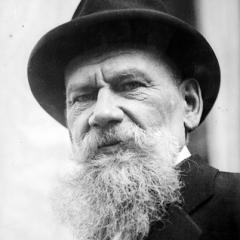
Leo Tolstoy
Leo Tolstoy

Leo Tolstoy was a Russian writer and thinker, a prominent representative of 19th-century Russian literature. His works deeply revealed social contradictions and human nature, and had a profound impact on the world. more

You May Also Like

“The people in their overwhelming majority are so feminine by nature and attitude that sober reasoning determines their thoughts and actions far less than emotion and feeling. And this sentiment is not complicated, but very simple and all of a piece. It does not have multiple shadings; it has a positive and a negative; love or hate, right or wrong, truth or lie, never half this way and half that way, never partially, or that kind of thing.”

“Yet alongside this rebellion against the father, a respect for and acceptance of his authority continued to exist. This ambivalent attitude toward authority—rebellion against it coupled with acceptance and submission—is a basic feature of every middle-class structure from the age of puberty to full adulthood and is especially pronounced in individuals stemming from materially restricted circumstances.”

“In terms of "quiet" bourgeois democracy two fundamental possibilities are open to the industrial worker: identification with the bourgeoisie, which holds a higher position in the social scale, or identification with his own social class, which produces its own anti-reactionary way of life. To pursue the first possibility means to envy the reactionary man, to imitate him, and, if the opportunity arises, to assimilate his habits of life. To pursue the second of these possibilities means to reject the reactionary man's ideologies and habits of life. Due to the simultaneous influence exercised by both social and class habits, these two possibilities are equally strong. The revolutionary movement also failed to appreciate the importance of the seemingly irrelevant everyday habits, indeed, very often turned them to bad account. The lower middle-class bedroom suite, which the "rabble" buys as soon as he has the means, even if he is otherwise revolutionary minded; the consequent suppression of the wife, even if he is a Communist; the "decent" suit of clothes for Sunday; "proper" dance steps and a thousand other "banalities," have an incomparably greater reactionary influence when repeated day after day than thousands of revolutionary rallies and leaflets can ever hope to counterbalance. Narrow conservative life exercises a continuous influence, penetrates every facet of everyday life; whereas factory work and revolutionary leaflets have only a brief effect.”

“One summer when Carol was attending day camp, Greta had an affair with a man named Mel Carter. He was an Eastern publicity representative for a film studio, and often instructed dinner parties to which we went in those days with accounts of the movies' coming of age. 'We have a picture coming up,' he said once, 'in which a character says "son of a bitch." Lots of exciting things are happening. Still, it's only a beginning. Much remains to be done.”

“This is an instance of the truism that, when switching from one recording medium to another, there is always a considerable data loss. As the Roman empire declined, continuing preservation of early texts would be dependent on the efforts of the book copyists in the Middle Ages - and good luck. Are there any resemblances to our current digitization concerns?”