Quotessence
Home / Quotes / Quote by Carl Sagan

Quote by Carl Sagan

“Science arouses a soaring sense of wonder. But so does pseudoscience. Sparse and poor popularizations of science abandon ecological niches that pseudoscience promptly fills. If it were widely understood that claims to knowledge require adequate evidence before they can be accepted, there would be no room for pseudoscience. But a kind of Gresham’s Law prevails in popular culture by which bad science drives out good.”

Quote by Carl Sagan

Work

The Demon-Haunted World: Science as a Candle in the Dark

In this seminal work, the author delves into the principles of scientific inquiry, critical analysis, and evidence-based reasoning. The book serves as a guide to discerning fact from fiction, advocating for the importance of skepticism and rationality in understanding the natural world. more

Author
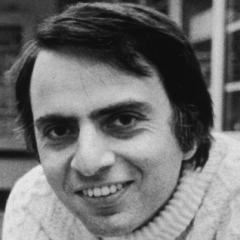
Carl Sagan
Carl Sagan

Carl Sagan was an American astronomer, cosmologist, author, and science communicator, born on November 9, 1934, in Brooklyn, New York. He is renowned for his profound research into the cosmos and his dedication to popularizing science. Sagan proposed numerous theories about the origin of the universe and life, and he made complex scientific knowledge accessible to the public with his unique perspective and clear, engaging writing style. more

You May Also Like

“I already know a thing or two. I know it’s not clothes that make women beautiful or otherwise, nor beauty care, nor expensive creams, nor the distinction or costliness of their finery. I know the problem lies elsewhere. I don’t know where. I only know it isn’t where women think. I look at the women in the streets of Saigon, and up-country. Some of them are very beautiful, very white, they take enormous care of their beauty here, especially up-country. They don’t do anything, just save themselves up, save themselves up for Europe, for lovers, holidays in Italy, the long six-months’ leaves every three years, when at last they’ll be able to talk about what it’s like here, this peculiar colonial existence, the marvellous domestic service provided by the houseboys, the vegetation, the dances, the white villas, big enough to get lost in, occupied by officials in distant outposts. They wait, these women. They dress just for the sake of dressing. They look at themselves. In the shade of their villas, they look at themselves for later on, they dream of romance, they already have huge wardrobes full of more dresses than they know what to do with, added together one by one like time, like the long days of waiting. Some of them go mad. Some are deserted for a young maid who keeps her mouth shut. Ditched. You can hear the word hit them, hear the sound of the blow. Some kill themselves.”

“En esta época no existía el individuo, no se distinguía el «yo» del «tú». El «yo apareció muy al comienzo a causa del miedo a la muerte; lo ajeno al «yo» se transformó en lo que se denomina el «tú». El hombre era entonces incapaz aún de temerse a sí mismo, su conocimiento de sí mismo no provenía más que del otro. Sólo el hecho de apresar o de ser apresado, de estar sometido o de someter, le confirmaba en su existencia. La tercera persona que no tiene relación directa con el «yo» y el «tú» es «él». Y «él» no aparece sino de forma paulatina. Más tarde, he descubierto que ocurre otro tanto con «él»: fue la existencia de seres diferentes la que hizo retroceder la conciencia del «yo» y del «tú». El hombre ha ido olvidado paulatinamente su «yo» en la lucha por la vida con el prójimo y, sumergido forzosamente en el mundo infinito, ya no es más que un granito de arena.”

“- ¿Tú no tienes madre? - No, no la tengo. Debió de interesarle mi orfandad porque oí crujir las sábanas como si su cuerpo buscara una postura más cómoda para escuchar. Pero yo no añadí nada. Al contrario, apunté la conversación hacia lo que a mí me interesaba. Lo hice con tiento, con miedo, como si a pesar de mis pocos años ya tuviese una sensación inconsciente de que pisaba terreno prohibido.”

“El hombre, ese animal que para su bien o su desgracia, nació inventándose el tiempo y se enfermó de concebir y separar nociones.”