Quotessence
Home / Quotes / Quote by Emily Dickinson

Quote by Emily Dickinson

“Bless God, he went as soldiers, His musket on his breast— Grant God, he charge the bravest Of all the martial blest! Please God, might I behold him In epauletted white— I should not fear the foe then— I should not fear the fight!”

Quote by Emily Dickinson

Author
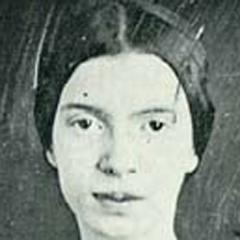
Emily Dickinson
Emily Dickinson

Emily Dickinson was a renowned American poet of the 19th century, known for her unique poetic style and profound introspection. Her poetry is characterized by its concise form and philosophical language, often exploring themes such as life, death, nature, and religion. more

You May Also Like

“Wars, wars, wars': reading up on the region I came across one moment when quintessential Englishness had in fact intersected with this darkling plain. In 1906 Winston Churchill, then the minister responsible for British colonies, had been honored by an invitation from Kaiser Wilhelm II to attend the annual maneuvers of the Imperial German Army, held at Breslau. The Kaiser was 'resplendent in the uniform of the White Silesian Cuirassiers' and his massed and regimented infantry... reminded one more of great Atlantic rollers than human formations. Clouds of cavalry, avalanches of field-guns and—at that time a novelty—squadrons of motor-cars (private and military) completed the array. For five hours the immense defilade continued. Yet this was only a twentieth of the armed strength of the regular German Army before mobilization. Strange to find Winston Churchill and Sylvia Plath both choosing the word 'roller,' in both its juggernaut and wavelike declensions, for that scene.”

“Power loves not the light of day, nor the attention of curious eyes. In darkness it thrives most...A lord may send his army hither and thither, but the true testing of his power is in those places where his army is not...Has he sent its long fingers far enough through the backstreets and alleys, into the drinking dens and the lending-houses, so that he may gather them unto himself and hold them firm without a single swordsman?”

“In the Second World War he took no public part, having escaped to a neutral country just before its outbreak. In private conversation he was wont to say that homicidal lunatics were well employed in killing each other, but that sensible men would keep out of their way while they were doing it. Fortunately this outlook, which is reminiscent of Bentham, has become rare in this age, which recognizes that heroism has a value independent of its utility. The Last Survivor of a Dead Epoch”