Quotessence
Home / Quotes / Quote by Mircea Eliade

Quote by Mircea Eliade

Work

The Sacred and the Profane: The Nature of Religion

This work examines the fundamental distinction between the sacred and the profane as a key element of religious experience. Drawing on historical and cross-cultural examples, the book analyzes how sacred space, time, and rituals shape human understanding of the divine and the world. It discusses the ways in which religious symbols and myths mediate between the transcendent and the ordinary, offering insights into the nature of belief and the structure of religious life. more

Author
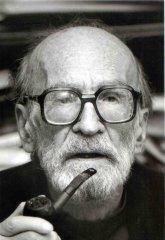
Mircea Eliade
Mircea Eliade

Mircea Eliade was a Romanian historian of religion and a prominent figure in the study of comparative religion. Born on March 13, 1907, in Bucharest, Romania, he passed away on April 22, 1986. His research focused on the history of religions, with a particular interest in the role of myth and ritual in human societies. more

You May Also Like

“In my living room there are two large bookcases, each one eight feet tall, and they have about five hundred books between them. If I step up to a shelf and look at the books one by one, I can remember something about each. As a historian once said, some stare at me reproachfully, grumbling that I have never read them. One may remind me vaguely of a time when I was interested in romantic novels. An old college text will elicit a pang of unhappiness about studying. Each book has its character, and even books I know very well also have this kind of wordless flavor. Now if I step back from the shelf and look quickly across both bookcases I speed up that same process a hundredfold. Impressions wash across my awareness. But each book still looks back in its own way, answering the rude brevity of my gaze, calling faintly to me out of the corner of my eye. At that speed many books remain wrapped in the shadows of my awareness--I know I have looked past them and I know they are there, but I refuse to call them to mind.”

“-You've got a . . . Lot of books, he said at last. -it's a sickness. -Are you . . . Seeing anyone for it? -I'm afraid it's untreatable. -is this the . . . Dewey decimal system? -No. But it's based on similar principles. Those are the British novelists. The French are in the kitchen. Homer, Virgil, and the other epics are by the tub. -I take it the . . . Transcendental its do better in the sunlight. -Exactly. -Do they need much water? -Not as much as you think. But lots of pruning. He pointed the volume toward a pile of books under my bed. -And the . . . Mushrooms? -The Russians. -Ah. -Who's winning? -Not me.”

“In the end Navidson is left with one page and one match. For a long time he waits in darkness and cold, postponing this final bit of illumination. At last though, he grips the match by the neck and after locating the friction strip sparks to life a final ball of light. First, he reads a few lines by match light and then as the heat bites his fingertips he applies the flame to the page. Here then is one end: a final act of reading, a final act of consumption. And as the fire rapidly devours the paper, Navidson's eyes frantically sweep down over the text, keeping just ahead of the necessary immolation, until as he reaches the last few words, flames lick around his hands, ash peels off into the surrounding emptiness, and then as the fire retreats, dimming, its light suddenly spent, the book is gone leaving nothing behind but invisible traces already dismantled in the dark.”