Quotessence
Home / Quotes / Quote by Karl Marx

Quote by Karl Marx

“In point of fact, however, whether a man works three days of the week for himself on his own field and three days for nothing on the estate of his lord, or whether he works in the factory or the workshop six hours daily for himself and six for his employer, comes to the same, although in the latter case the paid and unpaid portions of labour are inseparably mixed up with each other, and the nature of the whole transaction is completely masked by the intervention of a contract and the pay received at the end of the week. The gratuitous labour appears to be voluntarily given in the one instance, and to be compulsory in the other. That makes all the difference.”

Quote by Karl Marx

Work

Wage-Labour and Capital & Value, Price and Profit

Browse quotes and source details for this work. more

Author
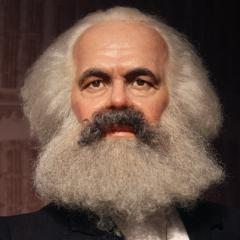
Karl Marx
Karl Marx

Karl Marx (May 5, 1818 - March 14, 1883) was a German philosopher, economist, sociologist, political theorist, and revolutionary. He is one of the founders of Marxism and his works, including 'Das Kapital' and 'The Communist Manifesto', have had a profound impact on the world. more

You May Also Like

“Employers conversely view the work of their employees, and the employees themselves, as a thing that belongs to them as a personal possession. This extends beyond some notion that workers have sold their labor or their “time” to the employer. Employers in practice completely own a worker during a designated period of work, and measure this ownership according to time. This is why time is managed and not the quantity or quality of tasks completed. The manner by which time is managed is similar to inventory management. When a worker fails to offer himself up for the designated hours, even despite the possibility of circumstances outside his control, the worker is expected to “make up” the time lost, much like reparations paid to an employer for stolen goods. Employers handle “lost hours” as part of loss prevention for physical products. The worker’s skills, ignobly called “human capital,” comports to an employer’s existing technologies for this reason: workers themselves become capital, and capital supports other capital through modification.”