Quotessence
Home / Quotes / Quote by Aleksandr Solzhenitsyn

Quote by Aleksandr Solzhenitsyn

“What a relief, Nadya thought; in that light he would not be able to tell that she had been crying. "You mean if it weren't for the blackout you wouldn't have come?" Dasha took up Shchagov's tone, flirting unconsciously, as she did with every unmarried man she met. "By no means, never. In bright light women's faces are deprived of all their charm; it reveals their spiteful expressions, their envious glances, their premature wrinkles, their heavy cosmetics." Nadya shuddered at the words "envious glances"—it was as if he had overheard their argument. Shchagov went on:" If I were a woman, I would make it a law that lights be kept low. Then everyone would soon have a husband." Dasha looked disapprovingly at Shchagov. He always talked that way, and she didn't like it. All his phrases seemed memorized, insincere.”

Quote by Aleksandr Solzhenitsyn

Work

The First Circle

This book is a profound exploration of the human condition, delving into the complexities of life, morality, and the search for meaning. Set in a fictional setting, it follows a group of individuals who are engaged in a quest for self-discovery and understanding. more

Author
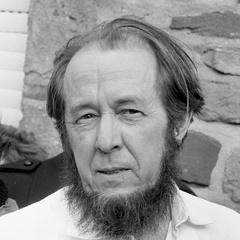
Aleksandr Solzhenitsyn

Aleksandr Solzhenitsyn, a Russian novelist, was born on December 11, 1918, and died on August 3, 2008. He is renowned for his works that profoundly exposed the dark side of the Soviet political system and is considered one of the greatest writers of the 20th century. more

You May Also Like

“The absolute monarch was supposed to serve the interests of the nation as a whole, to be the visible exponent and proof of the existence of such a common interest. The enlightened despotism was based on [Duc de] Rohan's "kings command the peoples and interest commands the king"; with the abolition of the king and sovereignty of the people, this common interest was in constant danger of being replaced by a permanent conflict among class interests and struggle for control of state machinery, that is, by a permanent civil war.”

“The political version of this was the seemingly clearcut choice before the New Left, to either transform the Establishment from within (the Long March through the institutions envisioned by the Prague Spring reformers and Western social democrats alike), or else to instigate an actual revolution in the streets. History teaches us that both options were illusory; national social democracy could temporarily flourish in the hothouse export-platform economies of Central Europe, but a resurgent neoliberalism was about to strangle the effective global demand this model depended on and thus reactivate the latent class tensions smoothed over by the golden age of state-monopoly Keynesianism; meanwhile the national-democratic and anti-colonial revolutions in the Second and Third Worlds could defeat the US Empire’s rampaging armies with guerilla tactics, but could hardly be expected to counter the far more insidious enemy of falling raw materials prices on world markets. Neither international solidarity actions nor neo-national political disruptions were, by themselves, really capable of challenging the henceforth global habitus of multinational capitalism; only truly transnational labor and political movements would be able to do that.”

“The most striking difference between the ancient and modern sophists is that the ancients were satisfied with a passing victory of the argument at the expense of truth, whereas the moderns want a more lasting victory at the expense of reality. In other words, one destroyed the dignity of human thought whereas the others destroy the dignity of human action. The old manipulators of logic were the concern of the philosopher, whereas the modern manipulators of facts stand in the way of the historian. For history itself is destroyed, and its comprehensibility—based upon the fact that it is enacted by men and therefore can be understood by men—is in danger, whenever facts are no longer held to be part and parcel of the past and present world, and are misused to prove this or that opinion.”