“Eliza has no use for the foolish romantic tradition that all women love to be mastered, if not actually bullied and beaten. "When you go to women," says Nietzsche, "take your whip with you." Sensible despots have never confined that precaution to women: they have taken their whips with them when they have dealt with men, and been slavishly idealized by the men over whom they have flourished the whip much more than by women. No doubt there are slavish women as well as slavish men; and women, like men, admire those that are stronger than themselves. But to admire a strong person and to live under that strong person's thumb are two different things. The weak may not be admired and hero-worshipped; but they are by no means disliked or shunned; and they never seem to have the least difficulty in marrying people who are too good for them. They may fail in emergencies; but life is not one long emergency: it is mostly a string of situations for which no exceptional strength is needed, and with which even rather weak people can cope if they have a stronger partner to help them out. Accordingly, it is a truth everywhere in evidence that strong people, masculine or feminine, not only do not marry stronger people, but do not show any preference for them in selecting their friends. When a lion meets another with a louder roar "the first lion thinks the last a bore." The man or woman who feels strong enough for two, seeks for every other quality in a partner than strength. The converse is also true. Weak people want to marry strong people who do not frighten them too much; and this often leads them to make the mistake we describe metaphorically as "biting off more than they can chew." They want too much for too little; and when the bargain is unreasonable beyond all bearing, the union becomes impossible: it ends in the weaker party being either discarded or borne as a cross, which is worse. People who are not only weak, but silly or obtuse as well, are often in these difficulties”
Quote by George Bernard Shaw
Work
Written by George Bernard Shaw, this play is renowned for its wit and social commentary. It follows the journey of Eliza Doolittle, a young woman from the East End of London, who is taken under the wing of Henry Higgins, a professor of phonetics. Higgins bets he can teach Eliza to speak and behave like a lady, thus transforming her into a different social class. The narrative delves into the complexities of language, social status, and the human condition. more
Author
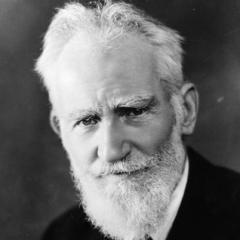
George Bernard Shaw (July 26, 1856 - November 2, 1950) was an Irish-British playwright, critic, and socialist. He is renowned for his satirical and witty dramatic works. more
You May Also Like
“But nothing's really free, is it? People always make you pay one way or another.”
“It's not the shit we face that defines us, it's how we deal with it.”
“No le digas a tu hija que este planeta se está yendo a la mierda.”
“[M]any people are so quick to classify events as miraculous that it devalues the word.”
“God is responsible for your shit but he is not responsible for its color.”