Quotessence
Home / Quotes / Quote by Friedrich Nietzsche

Quote by Friedrich Nietzsche

“Thus the aesthetically sensitive man stands in the same relation to the reality of dreams as the philosopher does to the reality of existence; he is a close and willing observer, for these images afford him an interpretation of life, and by reflecting on these processes he trains himself for life.”

Quote by Friedrich Nietzsche

Work

The Birth of Tragedy

Friedrich Nietzsche's seminal work delves into the psychological and aesthetic aspects of tragedy, examining its role in human life and its influence on art and philosophy. more

Author

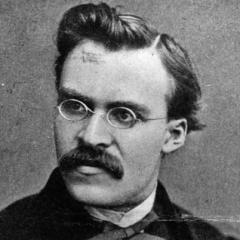
Friedrich Nietzsche
Friedrich Nietzsche

Friedrich Nietzsche was a German philosopher, cultural critic, poet, and writer whose works have had a profound impact on subsequent philosophy, literature, and thought. His ideas revolve around concepts such as the 'will to power', the 'Übermensch', and the 'eternal recurrence'. more

You May Also Like

“It is the subject of the will, i.e., his own volition, which fills the consciousness of the singer, often as a released and satisfied desire ; (joy), but still oftener as an inhibited desire ( grief), always as an affect, a passion, a moved state of mind. Besides this, however, and along with it, by the sight of surrounding nature, the singer becomes conscious of himself as the subject of pure will-less knowing, whose unbroken blissful peace now appears, in contrast to the stress of desire, which-is always restricted and always needy. The feeling of this contrast, this alternation, is really what the song as a whole expresses and what principally constitutes the lyrical state. In it pure knowing comes to us as it were to deliver us from willing and its strain; we follow, but only for moments; willing, the remembrance of our own personal ends, tears us anew from peaceful contemplation; yet ever again the next beautiful environment in which pure will-less knowledge presents itself to us lures us away from willing. Therefore, in the song and the lyrical mood, willing (the personal interest of the ends) and pure perception of the environment are wonderfully mingled; connections between them are sought and imagined; the subjective mood, the affection of the will, imparts its own hue to the perceived environment, and vice versa. Genuine song is the expression of the whole of this mingled and divided state of mind.”

“Everybody's lookin for God everywhere on the outside. He ain't in no book, and He ain't in no preacher, and He ain't in nothin or no one on the outside. You got to go inside 'cause that's where God is- in the deepest place inside you. And ain't nobody gon' make God tell you nothin. Ain't nobody gon' have no wisdome 'bout nothin if they thinks they can read 'bout it or hear about it from some man or woman. That got to come from revelation. That got to come from the Holy Spirit inside us, and that ain't somethin that can be bargained for. You can't achieve revelation. You can't work for what's free.”

“I have zero tolerance for the use of AI in any aspect of human creative endeavor. We can make a separate space for AI art, but AI trash passed as human art, is an abomination of creativity - for our imperfections bear the keynote of truth. Art is a testament to human struggle - remove the human, and it's art no more. Either you are an artist or you use AI, you cannot do both.”