Quotessence
Home / Quotes / Quote by Carl Sagan

Quote by Carl Sagan

“Frederick Douglass taught that literacy is the path from slavery to freedom. There are many kinds of slavery and many kinds of freedom, but reading is still the path.”

Quote by Carl Sagan

Author
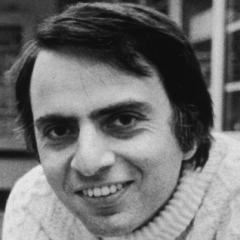
Carl Sagan
Carl Sagan

Carl Sagan was an American astronomer, cosmologist, author, and science communicator, born on November 9, 1934, in Brooklyn, New York. He is renowned for his profound research into the cosmos and his dedication to popularizing science. Sagan proposed numerous theories about the origin of the universe and life, and he made complex scientific knowledge accessible to the public with his unique perspective and clear, engaging writing style. more

You May Also Like

“What is a woman's place in this modern world? Jasnah Kholin's words read. I rebel against this question, though so many of my peers ask it. The inherent bias in the inquiry seems invisible to so many of them. They consider themselves progressive because they are willing to challenge many of the assumptions of the past. They ignore the greater assumption--that a 'place' for women must be defined and set forth to begin with. Half of the population must somehow be reduced to the role arrived at by a single conversation. No matter how broad that role is, it will be--by-nature--a reduction from the infinite variety that is womanhood. I say that there is no role for women--there is, instead, a role for each woman, and she must make it for herself. For some, it will be the role of scholar; for others, it will be the role of wife. For others, it will be both. For yet others, it will be neither. Do not mistake me in assuming I value one woman's role above another. My point is not to stratify our society--we have done that far to well already--my point is to diversify our discourse. A woman's strength should not be in her role, whatever she chooses it to be, but in the power to choose that role. It is amazing to me that I even have to make this point, as I see it as the very foundation of our conversation.”

“All freedom is relative—you know too well—and sometimes it’s no freedom at all, but simply the cage widening far away from you, the bars abstracted with distance but still there, as when they “free” wild animals into nature preserves only to contain them yet again by larger borders. But I took it anyway, that widening. Because sometimes not seeing the bars is enough”