Quotessence
Home / Quotes / Quote by Tennessee Williams

Quote by Tennessee Williams

“I'll tell you what I want. Magic! Yes, yes, magic! I try to give that to people. I misinterpret things to them. I don't tell the truth. I tell what ought to be truth. And if that is sinful, then let me be damned for it! - Don't turn the light on!”

Quote by Tennessee Williams

Work

A Streetcar Named Desire

Tennessee Williams' 'A Streetcar Named Desire' is a profound exploration of the complexities of human emotion. Set in the 1940s, the play delves into the psychological turmoil of Blanche DuBois, a fragile woman who seeks refuge with her sister, Stella, and her brother-in-law, Stanley. The narrative unfolds in a small, rundown apartment in New Orleans, where the characters' desires and obsessions collide, leading to a tragic climax. The play is renowned for its raw emotional intensity and Williams' poetic language, making it a cornerstone of American theater. more

Author
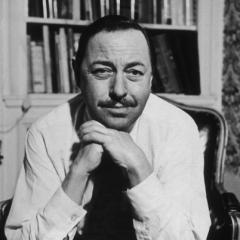
Tennessee Williams
Tennessee Williams

American playwright, renowned for his profound psychological portrayals and unique dramatic style. His notable works include 'A Streetcar Named Desire' and 'The Glass Menagerie'. more

You May Also Like

“Many things in this period have been hard to bear, or hard to take seriously. My own profession went into a protracted swoon during the Reagan-Bush-Thatcher decade, and shows scant sign of recovering a critical faculty—or indeed any faculty whatever, unless it is one of induced enthusiasm for a plausible consensus President. (We shall see whether it counts as progress for the same parrots to learn a new word.) And my own cohort, the left, shared in the general dispiriting move towards apolitical, atonal postmodernism. Regarding something magnificent, like the long-overdue and still endangered South African revolution (a jagged fit in the supposedly smooth pattern of axiomatic progress), one could see that Ariadne’s thread had a robust reddish tinge, and that potential citizens had not all deconstructed themselves into Xhosa, Zulu, Cape Coloured or ‘Eurocentric’; had in other words resisted the sectarian lesson that the masters of apartheid tried to teach them. Elsewhere, though, it seemed all at once as if competitive solipsism was the signifier of the ‘radical’; a stress on the salience not even of the individual, but of the trait, and from that atomization into the lump of the category. Surely one thing to be learned from the lapsed totalitarian system was the unwholesome relationship between the cult of the masses and the adoration of the supreme personality. Yet introspective voyaging seemed to coexist with dull group-think wherever one peered about among the formerly ‘committed’. Traditionally then, or tediously as some will think, I saw no reason to discard the Orwellian standard in considering modern literature. While a sort of etiolation, tricked out as playfulness, had its way among the non-judgemental, much good work was still done by those who weighed words as if they meant what they said. Some authors, indeed, stood by their works as if they had composed them in solitude and out of conviction. Of these, an encouraging number spoke for the ironic against the literal mind; for the generously interpreted interest of all against the renewal of what Orwell termed the ‘smelly little orthodoxies’—tribe and Faith, monotheist and polytheist, being most conspicuous among these new/old disfigurements. In the course of making a film about the decaffeinated hedonism of modern Los Angeles, I visited the house where Thomas Mann, in another time of torment, wrote Dr Faustus. My German friends were filling the streets of Munich and Berlin to combat the recrudescence of the same old shit as I read: This old, folkish layer survives in us all, and to speak as I really think, I do. not consider religion the most adequate means of keeping it under lock and key. For that, literature alone avails, humanistic science, the ideal of the free and beautiful human being. [italics mine] The path to this concept of enlightenment is not to be found in the pursuit of self-pity, or of self-love. Of course to be merely a political animal is to miss Mann’s point; while, as ever, to be an apolitical animal is to leave fellow-citizens at the mercy of Ideolo’. For the sake of argument, then, one must never let a euphemism or a false consolation pass uncontested. The truth seldom lies, but when it does lie it lies somewhere in between.”