Quotessence
Home / Quotes / Quote by Swami Vivekananda

Quote by Swami Vivekananda

“First let us clearly understand the position of monism: As manifested beings we appear to be separate, but our reality is one, and the less we think of ourselves as separate from that One, the better for us. The more we think of ourselves as separate from the Whole, the more miserable we become. From this monistic principle we get at the basis of ethics, and I venture to say that we cannot get any ethics from anywhere else.”

Quote by Swami Vivekananda

Work

Practical Vedanta

This book delves into the philosophical and spiritual teachings of Vedanta, offering insights into its principles and practices. It aims to provide readers with a comprehensive understanding of the system, including its origins, key concepts, and methods for personal growth and enlightenment. more

Author

Swami Vivekananda
Swami Vivekananda

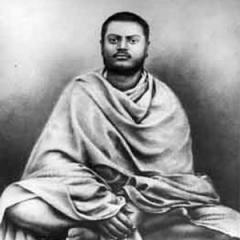
Swami Vivekananda (January 12, 1863 – July 4, 1902) was an Indian Hindu monk, philosopher, and social reformer. Born as Narendranath Datta in Kolkata, he was a chief disciple of the mystic Ramakrishna. He is best known for his historic speech at the 1893 Parliament of the World's Religions in Chicago, where he introduced Hinduism to the Western world. He founded the Ramakrishna Mission in 1897, focusing on social service, education, and interfaith harmony. His teachings emphasized self-realization, service to humanity, and the unity of all religions. He wrote extensively on yoga and Vedanta philosophy, influencing global spirituality and Indian nationalism. He died at the age of 39, leaving a lasting legacy as a bridge between Eastern and Western thought. more

You May Also Like

“The whole is the Absolute; but within it every particle is in a constant state of flux and change. It is unchangeable and changeable at the same time, Impersonal and Personal in one. The Personal God and all that exists in the universe are the same Impersonal Being seen through our minds. When we shall be rid of our minds, our little personalities, we shall become one with It. This is what is meant by "Thou art That". For we must know our true nature, the Absolute. The finite, manifested man forgets his source and thinks himself to be entirely separate. We, as personalised, differentiated beings, forget our reality, and the teaching of monism is not that we shall give up these differentiations, but we must learn to understand what they are.”

“Among all the miracles in Kildare, none appears to me more wonderful than th marvellous book which they say was written in the time of the Virgin [ie. St. Bridgit] at the dictation of an angel. It contains the Four Gospels according to St. Jerome, and almost every page is illustrated by drawings illuminated with a variety of brilliant colours. In one page you see the countenance of the Divine Majesty supernaturally pictured; in another, the mystic forms of the evangelists, with either six, four, or two wings: here are depicted the eagle, there the calf; here the face of man, there of a lion; with other figures in almost endless variety. If you observe them superficially, and in the usual careless manner, you would imagine them to be daubs, rather than careful compositions; expecting to find nothing exquisite. But if you apply yourself to a more close examination, and are able to penetrate the secrets of the art displayed in these pictures, you will find them so delicate and exquisite, so finely drawn, and the work of interlacing so elaborate, while the colours with which they are illuminated are so blended, and still so fresh, that you will be ready to assert that all this is the work of angelic, and not human skill.”

“Beware: All too often, We say What we hear others say. We think What we’re told that we think. We see What we’re permitted to see. Worse! We see what we’re told that we see. Repetition and pride are the keys to this. To hear and to see Even an obvious lie Again And again and again May be to say it, Almost by reflex Then to defend it Because we’ve said it And at last to embrace it Because we’ve defended it And because we cannot admit That we’ve embraced and defended An obvious lie. … Thus, without thought, Without intent, We make Mere echoes Of ourselves— And we say What we hear others say.”