Quotessence
Home / Quotes / Quote by Eli Siegel

Quote by Eli Siegel

Work

Damned Welcome: Aesthetic Realism Maxims

Browse quotes and source details for this work. more

Author
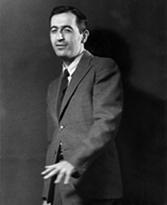
Eli Siegel
Eli Siegel

Eli Siegel was an American poet, born on August 16, 1902, and died on November 8, 1978. His poetry is known for its profound philosophical thoughts and unique artistic style. more

You May Also Like

“Does being true to one's self mean offering the literal truth or the truth that should have been, the truth of the image of one's self? It hardly matters by this time. By this time the border between seeing straight on and seeing round the corners of solid objects, between the world as smooth and coherent and the world as dissociated skinless particle, is thoroughly blurred. No longer a case of double vision, but of two separate eyes whose separate visions - what happened and what might have happened - come together in what we call the past, which we see with hindsight. Memory is revision. I have just destroyed another piece of my past, to tell a story.”

“What is the motive for this ‘fugitive’ way of saying “I”? It is motivated by Dasein’s falling; for as falling, it *flees* in the face of itself into the “they.” When the “I” talks in the ‘natural’ manner, this is performed by the they-self. What expresses itself in the ‘I’ is that Self which, proximally and for the most part, I am *not* authentically. When one is absorbed in the everyday multiplicity and the rapid succession [*Sich-jagen] of that with which one is concerned, the Self of the self-forgetful “I am concerned” shows itself as something simple which is constantly selfsame but indefinite and empty. Yet one *is* that with which one concerns oneself. In the ‘natural’ ontical way in which the “I” talks, the phenomenal content of the Dasein which one has in view in the "I" gets overlooked; but this gives *no justification for our joining in this overlooking of it*, or for forcing upon the problematic of the Self an inappropriate ‘categorial’ horizon when we Interpret the “I” ontologically. Of course by thus refusing to follow the everyday way in which the “I” talks, our ontological Interpretation of the ‘I’ has by no means *solved* the problem; but it has indeed *prescribed the direction* for any further inquiries. In the “I,” we have in view that entity which one is in ‘being-in-the-world’. Being-already-in-a-world, however, as Being-alongside-the-ready-to-hand-within-the-world, means equiprimordially that one is ahead of oneself. With the ‘I’, what we have in view is that entity for which the *issue* is the Being of the entity that it is. With the ‘I’, care expresses itself, though proximally and for the most part in the ‘fugitive’ way in which the “I” talks when it concerns itself with something. The they-self keeps on saying “I” most loudly and most frequently because at bottom it *is not authentically* itself, and evades its authentic potentiality-for-Being. If the ontological constitution of the Self is not to be traced back either to an “I”-substance or to a ‘subject’, but if, on the contrary, the everyday fugitive way in which we keep on saying “I” must be understood in terms of our *authentic* potentiality-for-Being, then the proposition that the Self is the basis of care and constantly present-at-hand, is one that still does not follow. Selfhood is to be discerned existentially only in one’s authentic potentiality-for-Being-one’s-Self—that is to say, in the authenticity of Dasein’s Being *as care*. In terms of care the *constancy of the Self*, as the supposed persistence of the *subjectum*, gets clarified. But the phenomenon of this authentic potentiality-for-Being also opens our eyes for the *constancy of the Self*, in the double sense of steadiness and steadfastness, is the *authentic* counter-possibility to the non-Self-constancy which is characteristic of irresolute falling. Existentially, “*Self-constancy*” signifies nothing other than anticipatory resoluteness. The ontological structure of such resoluteness reveals the existentiality of the Self’s Selfhood." ―from_Being and Time_. Translated by John Macquarrie & Edward Robinson, pp. 368-369”

“Elliott was disarmingly bright, according to everyone who knew him, an avid reader of Dostoevsky, Kafka, Beckett, Stendhal, Freud, the Buddha, all of whom destabilized notions of identity. I think he knew how little we know about who we are. The idea comes through in lyrics. “I don’t know who I am,” he says simply; at times he wishes he were no one. He’s a stickman shooting blanks at emptiness, living with “one dimension dead.” He’s an invisible man with a see-through mind. He’s a junkyard full of false starts. He’s a ghost-writer, feeling hollow.”

“My sense of self hinges upon the belief that what I do matters. That belief has compelled me to venture far from home life, and to immerse myself in the lives of strangers in the hope that my work will have an impact and connect people in some intangible way, that I can contribute some greater good.”