Quotessence
Home / Quotes / Quote by Mark Twain

Quote by Mark Twain

Author

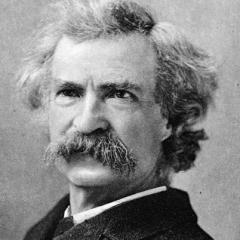
Mark Twain
Mark Twain

Mark Twain, born Samuel Langhorne Clemens, was a renowned American author and humorist in the 19th century. His works are characterized by humor, satire, and profound social insight, with notable novels such as 'The Adventures of Tom Sawyer' and 'The Adventures of Huckleberry Finn'. more

You May Also Like

“Words would just jump out of my mouth before I even realized what I was thinking. I was told in no uncertain terms that this was not the way we treated our elders, or anyone for that matter. Our culture is about the respect for everything around us. At that time, they didn’t realize I had Tourette’s.”

“I feel you calling, in the autumn sweet transformation. I have reached my brightest green to the gold burning sun. I have folded my colours into the wind, bright colours taken to the sky. My silk has gone to moisture in the rising atmosphere and I am your colours again, deep and warm. I hear your calling and I answer, I come back to you, to slip inside the dark. Will I be found by the decaying things? Will I be found by the roots and drunk by tree and flower? Will I slip and mingle and roll along, find my way to a river and with it dance, and give myself in a sigh to the ocean? Will I scatter, a few fragments of sand – my body to glisten beneath a caress of moonlight as I make my way towards no more as I find my way to forever”

“Life with God is an invitation into a world where most of what makes sense to you crumbles. It's far richer than you imagined, far less orderly and sensible, and far more mysterious. Like Job, once you begin to see the wonder of it, you find yourself awestruck and somehow, satisfied.”

“You've a perfect right to call me as impractical as a dormouse, and to feel I'm out of touch with life. But this is the point where we simply can't see eye to eye. We've nothing whatever in common. Don't you see. . . it's not an accident that's drawn me from Blake to Whitehead, it's a certain line of thought which is fundamental to my whole approach. You see, there's something about them both. . . They trusted the universe. You say I don't know what the modern world's like, but that's obviously untrue. Anyone who's spent a week in London knows just what it's like. . . if you mean neurosis and boredom and the rest of it. And I do read a modern novel occasionally, in spite of what you say. I've read Joyce and Sartre and Beckett and the rest, and every atom in me rejects what they say. They strike me as liars and fools. I don't think they're dishonest so much as hopelessly tired and defeated." Lewis had lit his pipe. He did it as if Reade were speaking to someone else. Now he said, smiling faintly, "I don't think we're discussing modern literature." Reade had an impulse to call the debater's trick, but he repressed it. Instead he said quietly, "We're discussing modern life, and you brought up the subject. And I'm trying to explain why I don't think that murders and wars prove your point. I'm writing about Whitehead because his fundamental intuition of the universe is the same as my own. I believe like Whitehead that the universe is a single organism that somehow takes account of us. I don't believe that modern man is a stranded fragment of life in an empty universe. I've an instinct that tells me that there's a purpose, and that I can understand that purpose more deeply by trusting my instinct. I can't believe the world is meaningless. I don't expect life to explode in my face at any moment. When I walk back to my cottage, I don't feel like a meaningless fragment of life walking over a lot of dead hills. I feel a part of the landscape, as if it's somehow aware of me, and friendly.”