Quotessence
Home / Quotes / Quote by Alfred North Whitehead

Quote by Alfred North Whitehead

Work

Process and reality: an essay in cosmology

This book delves into the philosophical and scientific concepts of process and reality, examining their implications in the field of cosmology. more

Author
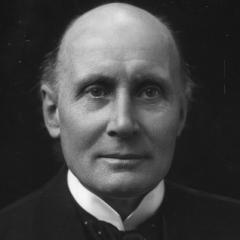
Alfred North Whitehead

Alfred North Whitehead was a British mathematician, philosopher, born on February 15, 1861, and died on December 30, 1947. He is known for his contributions to mathematics, logic, philosophy, and the philosophy of science, particularly for his co-authorship of 'Principia Mathematica' with Bertrand Russell. more

You May Also Like

“MATERIAL SUBSTANCE was criticized by Berkeley with such telling effect that his name has reverberated through all subsequent philosophy. Berkeley's treatment of the notion of matter is so well known as to need hardly more than a mention. So far from denying the external world which we know, Berkeley corroborated it. It was the scholastic notion of a material substance unapproachable by us, BEHIND the external world, deeper and more real than it, and needed to support it, which Berkeley maintained to be the most effective of all reducers of the external world to unreality. Abolish that substance, he said, believe that God, whom you can understand and approach, sends you the sensible world directly, and you confirm the latter and back it up by his divine authority. Berkeley's criticism of 'matter' was consequently absolutely pragmatistic. Matter is known as our sensations of colour, figure, hardness and the like. They are the cash-value of the term. The difference matter makes to us by truly being is that we then get such sensations; by not being, is that we lack them. These sensations then are its sole meaning. Berkeley doesn't deny matter, then; he simply tells us what it consists of. It is a true name for just so much in the way of sensations. Locke, and later Hume, applied a similar pragmatic criticism to the notion of SPIRITUAL SUBSTANCE. I will only mention Locke's treatment of our 'personal identity.' He immediately reduces this notion to its pragmatic value in terms of experience. It means, he says, so much consciousness,' namely the fact that at one moment of life we remember other moments, and feel them all as parts of one and the same personal history. Rationalism had explained this practical continuity in our life by the unity of our soul-substance. But Locke says: suppose that God should take away the consciousness, should WE be any the better for having still the soul-principle? Suppose he annexed the same consciousness to different souls, | should we, as WE realize OURSELVES, be any the worse for that fact? In Locke's day the soul was chiefly a thing to be rewarded or punished. See how Locke, discussing it from this point of view, keeps the question pragmatic: Suppose, he says, one to think himself to be the same soul that once was Nestor or Thersites. Can he think their actions his own any more than the actions of any other man that ever existed? But | let him once find himself CONSCIOUS of any of the actions of Nestor, he then finds himself the same person with Nestor. ... In this personal identity is founded all the right and justice of reward and punishment. It may be reasonable to think”

“The boy's friends come over to lead him away, and at that moment, improbably, Locke's gaze lifts. His tawny fox eyes meet mine and widen in surprise. I am immobilised, my heart speeding. I brace myself for more scorn, but then one corner of his mouth lifts. He winks, as if in acknowledgement of being caught out. As if we're sharing a secret. As if he thinks I am not loathly, as though he does not find my mortality contagious.”

“Human nature with all its infirmities and deprivation is still capable of great things. It is capable of attaining to degrees of wisdom and goodness, which we have reason to believe, appear as respectable in the estimation of superior intelligences. Education makes a greater difference between man and man, than nature has made between man and brute. The virtues and powers to which men may be trained, by early education and constant discipline, are truly sublime and astonishing. Isaac Newton and John Locke are examples of the deep sagacity which may be acquired by long habits of thinking and study.”

“Fairy tales are full of girls who wait, who endure, who suffer. Good girls. Obedient girls. Girls who crush nettles until their hands bleed. Girls who haul water for witches. Girls who wander through deserts or sleep in ashes or make homes for transformed brothers in the woods. Girls without hands, without eyes, without the power of speech, without any power at all. But then a prince rides up and sees the girl and finds her beautiful. Beautiful, not despite her suffering, but because of it. And when I saw that note in my bag, I thought that maybe I was no longer stuck in a fairy tale, maybe I could be the hero of one.”