“As children get older, this incidental outdoor activity--say, while waiting to be called to eat--becomes less bumptious, physically and entails more loitering with others, sizing people up, flirting, talking, pushing, shoving and horseplay. Adolescents are always being criticized for this kind of loitering, but they can hardly grow up without it. The trouble comes when it is done not within society, but as a form of outlaw life. The requisite for any of these varieties of incidental play is not pretentious equipment of any sort, but rather space at an immediately convenient and interesting place. The play gets crowded out if sidewalks are too narrow relative to the total demands put on them. It is especially crowded out if the sidewalks also lack minor irregularities in building line. An immense amount of both loitering and play goes on in shallow sidewalk niches out of the line of moving pedestrian feet.”
Quote by Jane Jacobs
Work
This influential work challenges conventional urban planning theories of the 1950s and 1960s, particularly those advocating for large-scale clearance, superblocks, and strict separation of uses. The author draws on close observation of city streets and neighborhoods to argue that vibrant, safe, and economically diverse urban areas arise from dense, mixed-use environments with short blocks and a constant flow of pedestrians. The book critiques the principles of figures like Le Corbusier and Ebenezer Howard, as well as the policies of urban renewal that devastated many existing communities. Instead, it proposes four essential generators of urban diversity and emphasizes the importance of local knowledge, informal social networks, and the intricate ballet of street life in maintaining a healthy city. The work remains a foundational text in urban studies, planning, and sociology. more
Author
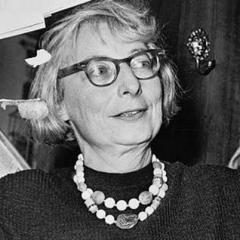
Jane Jacobs, an American journalist and urban theorist, was born on May 4, 1916, and passed away on April 25, 2006. She is renowned for her profound insights into urban life and her unique perspectives on urban planning. Her book, 'The Death and Life of Great American Cities,' had a revolutionary impact on modern urban planning. more
You May Also Like
“Always believe in good and happiness. Never except "I can't" Always say I can..”
“I'm not the kind of person who wants to just melt into the background and be one of many.”