Quotessence
Home / Quotes / Quote by Hermann Hesse

Quote by Hermann Hesse

“How foolish to wear oneself out in vain longing for warmth! Solitude is independence. It has been my wish and with the years I had attained it. It was cold. Oh, cold enough! But it was also still, wonderfully still and vast like the cold stillness of space in which the stars revolve.”

Quote by Hermann Hesse

Author
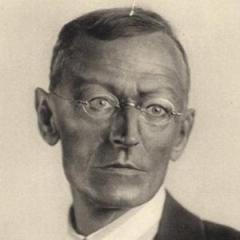
Hermann Hesse
Hermann Hesse

Hermann Hesse was a German poet and novelist, born on July 2, 1877, and died on August 9, 1962. Known for his profound psychological descriptions and exploration of human nature, his works include classics such as 'Steppenwolf' and 'The Glass Bead Game'. more

You May Also Like

“This Steppenwolf of ours has always been aware of at least the Faustian two-fold nature within him. He has discovered that the one-fold of the body is not inhabited by a one-fold of the soul, and that at best he is only at the beginning of a long pilgrimage towards this ideal harmony. He would like either to overcome the wolf and become wholly man or to renounce mankind and at last to live wholly a wolf's life. It may be presumed that he has never carefully watched a real wolf. Had he done so he would have seen, perhaps, that even animals are not undivided in spirit. With them, too, the well-knit beauty of the body hides a being of manifold states and strivings. The wolf, too, has his abysses. The wolf, too, suffers. No, back to nature is a false track that leads nowhere but to suffering and despair. Harry can never turn back again and become wholly wolf, and could he do so he would find that even the wolf is not of primeval simplicity, but already a creature of manifold complexity. Even the wolf has two, and more than two, souls in his wolf's breast, and he who desires to be a wolf falls into the same forgetfulness as the man who sings: "If I could be a child once more!" He who sentimentally sings of blessed childhood is thinking of the return to nature and innocence and the origin of things, and has quite forgotten that these blessed children are beset with conflict and complexities and capable of all suffering. There is, in fact, no way back either to the wolf or to the child. From the very start there is no innocence and no singleness. Every created thing, even the simplest, is already guilty, already multiple. It has been thrown into the muddy stream of being and may never more swim back again to its source. The way to innocence, to the uncreated and to God leads on, not back, not back to the wolf or to the child, but ever further into sin, ever deeper into human life. Nor will suicide really solve your problem, unhappy Steppenwolf. You will, instead, embark on the longer and wearier and harder road of life. You will have to multiply many times your two-fold being and complicate your complexities still further. Instead of narrowing your world and simplifying your soul, you will have to absorb more and more of the world and at last take all of it up in your painfully expanded soul, if you are ever to find peace. This is the road that Buddha and every great man has gone, whether consciously or not, insofar as fortune favored his quest. All births mean separation from the All, the confinement within limitation, the separation from God, the pangs of being born ever anew. The return into the All, the dissolution of painful individuation, the reunion with God means the expansion of the soul until it is able once more to embrace the All.”

“[…] he still closes his eyes to the truth, refusing to acknowledge that clinging desperately to the notion of self, desperately wanting not to die, is the surest route to eternal death. On the other hand, the ability to die, to slough off one’s skin like a snake, to commit oneself to incessant self-transformation is what leads the way to immortality.”

“Just as I dress and go out to visit the professor and exchange a few more or less insincere compliments with him, without really wanting to at all, so it is with the majority of men day by day and hour by hour in their daily lives and affairs. Without really wanting to at all, they pay calls and carry on conversations, sit out their hours at desks and on office chairs; and it is all compulsory, mechanical and against the grain, and it could all be done or left undone just as well by machines; and indeed it is this never-ceasing machinery that prevents their being, like me, the critics of their own lives and recognizing the stupidity and shallowness, the hopeless tragedy and waste of the lives they lead, and the awful ambiguity grinning over it all. And they are right, right a thousand times to live as they do, playing their games and pursuing their business, instead of resisting the dreary machine and staring into the void as I do, who have left the track. Let no one think that I blame other men, though now and then in these pages I scorn and even deride them, or that I accuse them of the responsibility of my personal misery. But now that I have come so far, and standing as I do on the extreme verge of life where the ground falls away before me into bottomless darkness, I should do wrong and I should lie if I pretended to myself or to others that that machine still revolved for me and that I was still obedient to the eternal child's play of that charming world.”

“You have a picture of life within you, a faith, a challenge, and you were ready for deeds and sufferings and sacrifices, and then you became aware by degrees that the world asked no deeds and no sacrifices of you whatever, and that life is no poem of heroism with heroic parts to play and so on, but a comfortable room where people are quite content with eating and drinking, coffee and knitting, cards and radio music. And whoever wants more and has got it in him - the heroic and the beautiful, and the reverence for the great poets or for the saints - is a fool and a Don Quixote.”

“The thing he most compulsively desired, most stubbornly searched and strove for, was granted to him, but more abundantly than is good for a human being. Initially all he dreamed of and wished for, it later became his bitter lot. Those who live for power are destroyed by power, those who live for money by money; service is the ruin of the servile, pleasure the ruin of the pleasure-seeker. Thus it was Steppenwolf's independence that proved his downfall.”