Quotessence
Home / Quotes / Quote by Bertrand Russell

Quote by Bertrand Russell

“I was made to learn Latin and Greek, but I resented it, being of opinion that it was silly to learn a language that was no longer spoken. I believe that all the little good I got from years of classical studies I could have got in adult life in a month.”

Quote by Bertrand Russell

Work

Sceptical Essays

This book delves into the principles of skepticism, examining various arguments and perspectives on critical thinking and rational inquiry. more

Author

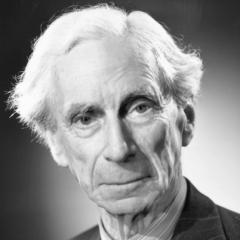
Bertrand Russell
Bertrand Russell

Bertrand Russell was a British philosopher, mathematician, and logician born on May 18, 1872, and died on February 2, 1970. He is known for his contributions to logic and mathematics, particularly in the fields of mathematical logic and philosophical analysis. His works spanned a wide range of subjects, including ethics, political philosophy, history, and literary criticism. more

You May Also Like

“We can see our forests vanishing, our water-powers going to waste, our soil being carried by floods into the sea; and the end of our coal and our iron is in sight. But our larger wastes of human effort, which go on every day through such of our acts as are blundering, ill-directed, or inefficient, and which Mr. Roosevelt refers to as a lack of" national efficiency," are less visible) less tangible, and are but vaguely appreciated. We can see and feel the waste of material things. Awkward, inefficient, or ill-directed movements of men, however, leave nothing visible or tangible behind them. Their appreciation calls for an act of memory, an effort of the imagination. And for this reason, even though our daily loss from this source is greater than from our waste of material things, the one has stirred us deeply, while the other has moved us but little.”

“Decentralization makes technology more complicated and further out of reach for basic users, rather than simpler and more accessible. While it’s possible to fix this by adding new layers that can speed things up, doing so makes the whole system more centralized, which defeats the purpose.”

“In basic microeconomics textbooks, even when welfare gets attention, it is in the domain of efficient outcomes. Redistribution through taxes is first introduced as a big ‘no go’ domain with concepts of deadweight loss. However, inefficiency out of market behaviour and market outcomes is plainly ignored and overlooked. Approximately, $600 million daily is needed to feed every extremely poor person, yet about $2.75 billion value of food is wasted every day, according to Food and Agriculture Organization. Consequently, 9 million people die every year from hunger while one-third of all food is wasted. This gross inefficiency in economic resources is not captured or discussed. According to Food and Agriculture Organization of the United Nations, globally, per capita food supply increased from about 2,200 kcal per day in the early 1960s to more than 2,903 kcal per day by 2014. But under capitalism, the market allocates goods including even food to only those who can pay its price. It does not make a difference whether the willingness to pay is less than the price due to ‘preference’ or due to ‘poverty’. Yet, mainstream economics claims consumer sovereignty.”