Quotessence
Home / Quotes / Quote by Thomas Mann

Quote by Thomas Mann

“But were ideals, after all, meant to be realised? No, a thousand times no! We might long for the stars, but should we ever reach them? No, hope, not realization, was the most beautiful thing in life: "L'espérance, toute trompeuse qu'elle soit, sert au moins à nous mener à la fin de la vie par un chemin agréable". La Rochefoucauld said that...”

Quote by Thomas Mann

Work

Buddenbrooks: The Decline of a Family

Browse quotes and source details for this work. more

Author
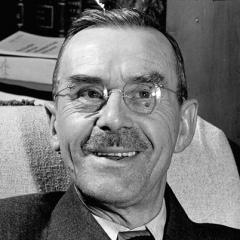
Thomas Mann
Thomas Mann

Thomas Mann, born on June 6, 1875, and died on August 12, 1955, was a German novelist and one of the greatest writers of the 20th century. Known for his profound psychological portrayals and rich imagination, his works extensively covered themes such as individual and society, history and reality. His masterpieces include 'Buddenbrooks' and 'The Magic Mountain'. more

You May Also Like

“My eyes roved over the walls covered with my collages and prints of famous paintings. Magritte, Kandinsky, Kahlo. My origami shapes hung from fishing wire, dangling over my bed. They shivered in the slight breeze blowing through my open window. It was my own little escape pod, but none of it was enough tonight.”

“I loved my bedroom... the vanity with the warped mirror, the squat chairs without armrests, the elaborate, oriental dressing screen. I loved curving my body into the velvet sofa, books piled at my feet, the dusty, floor-length curtains pushed back from the windows so I could see the sky. At night the purple-fringed lampshades turned the light a hue somewhere between lilac and dusky plum.”

“The fairy let her go and pulled aside a piece of bright gold-and-pink silk hanging on the wall. Behind it was the fairy's own private room. She had a soft bed of bright green moss with several iridescent feathers for a counterpane. A shelf mushroom served as an actual shelf displaying an assortment of dried flowers and pretty gewgaws the fairy had collected. There was a charming little dining table, somewhat bold in irony: It was the cheery but deadly red-and-white amanita. The wide top was set with an acorn cap bowl and jingle shell charger. In the corner, a beautifully curved, bright green leaf collected drops from somewhere in the celling much like the water barrel did, but this was obviously for discreet fairy bathing. An assortment of tiny buds, rough seeds, and spongy moss were arranged neatly on a piece of gray driftwood nearby to aid in cleansing.”

“Light flooded their senses; for a split second Olivia, blinking in its brilliance, thought the light was actually yellow. Then she blinked again, and the room itself was yellow: yellow roses climbing the walls, a white and yellow canopy- of course, a canopy- matching the wadded silk bedspread, braided yellow rugs strewn across the bare wooden floorboards. Abby gave a little cry and ran to the curved windows opposite, where a riot of yellow and pink throw pillows lined the window seat.”

“Not only was the four-poster- a lofty structure that would have put princesses and peas to shame- a place of rest and relaxation but it was, and had been for quite some time now, a portal for her magic carpet escapades. It was there that Estelle first began to practice what Marjan had called "eating at the edge of a ready 'sofreh'." Estelle always followed the same routine when assembling her dinner 'sofreh' on her bed. First, she would spread the paisley blanket Marjan had given her, tucking the fringed ends in tight around the sides of her mattress. Then, having already wetted a pot of jasmine tea, she would dig a trivet into the blanket's left corner and place the piping pot on top of it. Following the Persian etiquette of placing the main dishes at the center of the 'sofreh', Estelle would position the plate of saffron 'chelow' (with crunchy 'tadig'), the bowl of stew or soup that was the day's special, and the 'lavash' or 'barbari' bread accordingly. She would frame the main dishes with a small plate of 'torshi', pickled carrots and cucumbers, as well as a yogurt dip and some feta cheese with her favorite herb: balmy lemon mint. Taking off her pink pom-pom house slippers, Estelle would then hoist herself onto her high bed and begin her ecstatic epicurean adventure. She savored every morsel of her nightly meal, breathing in the tingle of sumac powder and nutmeg while speaking to a framed photograph of Luigi she propped up on its own trivet next to the tea. Dinner was usually Persian, but her dessert was always Italian: a peppermint cannoli or marzipan cherry, after which she would turn on the radio, always set to the 'Mid-West Ceili Hour', and dream of the time when a young Luigi made her do things impossible, like when he convinced her to enter the Maharajah sideshow and stand on the tallest elephant's trunk during carnival season in her seaside Neapolitan town.”