Quotessence
Home / Quotes / Quote by Simone de Beauvoir

Quote by Simone de Beauvoir

Work

The Second Sex

Written by Simone de Beauvoir, this influential book delves into the complexities of gender identity and the social construction of femininity and masculinity. It examines the ways in which women are marginalized and the implications of this on their personal and societal lives. more
Author

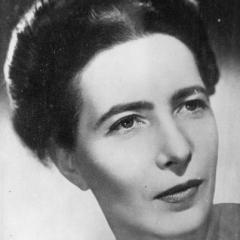
Simone de Beauvoir
Simone de Beauvoir

Simone de Beauvoir was a French writer, philosopher, feminist, and social activist. Known for her profound philosophical thoughts and her advocacy for women's status, she is one of the most influential female thinkers of the 20th century. Her works spanned various genres, including novels, philosophical essays, plays, and memoirs, with her most famous work being 'The Second Sex'. more

You May Also Like

“Ugh, writer's block. The best thing to do is to forget about everything you're trying to do. Get away from your writing station, kick your feet up and relax. Then allow your mind to just wander. Don't stop it. Just let yourself think of anything, no mater how silly the thoughts seem. Remember, not to judge these thoughts. This will open up your creative receptors. You'll begin to think outside the box. Then the good stuff will start racing through you. That's when you start writing!”

“Every time the long-forgotten people of the past are remembered, they are born again!”

“Treating Abuse Today (Tat), 3(4), pp. 26-33 Freyd: I see what you're saying but people in psychology don't have a uniform agreement on this issue of the depth of -- I guess the term that was used at the conference was -- "robust repression." TAT: Well, Pamela, there's a whole lot of evidence that people dissociate traumatic things. What's interesting to me is how the concept of "dissociation" is side-stepped in favor of "repression." I don't think it's as much about repression as it is about traumatic amnesia and dissociation. That has been documented in a variety of trauma survivors. Army psychiatrists in the Second World War, for instance, documented that following battles, many soldiers had amnesia for the battles. Often, the memories wouldn't break through until much later when they were in psychotherapy. Freyd: But I think I mentioned Dr. Loren Pankratz. He is a psychologist who was studying veterans for post-traumatic stress in a Veterans Administration Hospital in Portland. They found some people who were admitted to Veteran's hospitals for postrraumatic stress in Vietnam who didn't serve in Vietnam. They found at least one patient who was being treated who wasn't even a veteran. Without external validation, we just can't know -- TAT: -- Well, we have external validation in some of our cases. Freyd: In this field you're going to find people who have all levels of belief, understanding, experience with the area of repression. As I said before it's not an area in which there's any kind of uniform agreement in the field. The full notion of repression has a meaning within a psychoanalytic framework and it's got a meaning to people in everyday use and everyday language. What there is evidence for is that any kind of memory is reconstructed and reinterpreted. It has not been shown to be anything else. Memories are reconstructed and reinterpreted from fragments. Some memories are true and some memories are confabulated and some are downright false. TAT: It is certainly possible for in offender to dissociate a memory. It's possible that some of the people who call you could have done or witnessed some of the things they've been accused of -- maybe in an alcoholic black-out or in a dissociative state -- and truly not remember. I think that's very possible. Freyd: I would say that virtually anything is possible. But when the stories include murdering babies and breeding babies and some of the rather bizarre things that come up, it's mighty puzzling. TAT: I've treated adults with dissociative disorders who were both victimized and victimizers. I've seen previously repressed memories of my clients' earlier sexual offenses coming back to them in therapy. You guys seem to be saying, be skeptical if the person claims to have forgotten previously, especially if it is about something horrible. Should we be equally skeptical if someone says "I'm remembering that I perpetrated and I didn't remember before. It's been repressed for years and now it's surfacing because of therapy." I ask you, should we have the same degree of skepticism for this type of delayed-memory that you have for the other kind? Freyd: Does that happen? TAT: Oh, yes. A lot.”