Quotessence
Home / Quotes / Quote by Tom Waits

Quote by Tom Waits

Work

The Early Years: The Lyrics, 1971-1983

Browse quotes and source details for this work. more

Author
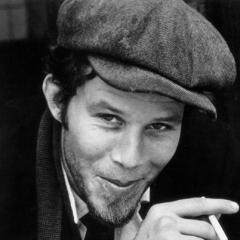
Tom Waits
Tom Waits

Tom Waits, born on December 7, 1949, is an influential American singer-songwriter and actor. Known for his unique musical style that blends blues, jazz, folk, and country elements, he is often referred to as 'the oddball of American music.' Waits is renowned for his distinctive voice and expressive lyrics, and his work has earned high praise in both the music and literary worlds. more

You May Also Like

“The truck takes off again on Jalan 15 Oktober, in a cloud of dust, papers and tatters. A half-naked boy, coming out of nowhere, waves at us as if nothing had happened. For a moment, it almost feels like life could go on, just as it always does. But that’s not the case. There’s no time for life here anymore.”

“The Americans gave it a name, PTSD — Post Traumatic Stress Disorder. I had heard about it before: it was something that had to do with army men coming back from the frontline, veterans who had been under a lot of stress. Or survivors of terrorist attacks, bombings, massacres, or big accidents. What I didn’t know was that journalists were also considered a category ‘at risk,’ particularly the ones who had covered conflict or reported in war zones crisis zones. All those who had witnessed episodes of violence, killings, traumatic events, and who had learnt to work and live coping with the anxiety from nearby fighting and constant danger. I saw many of my colleagues devastated — broken — by what they had seen, which often I had seen too. Some never managed to really go back to their normal lives and once, after a crisis that had hit them harder than the many others, decided they had had enough. Among many terrible news came those of the suicide of Stephanie Vaessen’s husband and cameraman — him and Stephanie were two of the people I had shared the tragic days in East Timor with. No worries though. I was doing just fine, as I’d tell myself. At the end of the day, I genuinely believed it: I never really took as many risks as many of the colleagues I had met or shared the most traumatic experiences in the field with, hence I had probably been exposed to a lot less stress. (...)”

“Trump assimilated this decades-long conservative tradition not through studying such figures but through instinct and campaign-trail improvisation. Like Chambers, Burnham, and Buchanan, outsiders enamored of power, Trump relishes iconoclasm and rupture, seeks to upend the status quo, and loathes liberal elites and foreign-policy experts. Trump may seem an unlikely heir to these men and the movements they shaped, which were shot through with Christian moralism and at times with elitism. But he has cannily and successfully cast himself not as a refined exemplar of Western cultural and civilizational virtues but as their toughest defender from enemies without and within.”

“mesembrianthemum should be so spelt. In a cumbrous word whose length can only be excused if it is at least significant to the learned, it is absurd not to correct the misspelling y for i; the y at once puts the Greek scholar off the track by suggesting embryo or bryony (Greek βρύω swell, burgeon), and forbids him to think of μεσημβρία noon, which is what he ought to be thinking of. When a word like rhyme that is familiar to everyone has settled itself into our hearts and minds with a wrong spelling, there is much to be said for refraining from correction; but with the y of m. no one has tender associations.”

“Because reasoning about causes and effects is a very difficult thing, and I believe the only judge of that can be God. We are already hard put to establish a relationship between such an obvious effect as a charred tree and the lightning bolt that set fire to it, so to trace sometimes endless chains of causes and effects seems to me as foolish as trying to build a tower that will touch the sky.”