Quotessence
Home / Quotes / Quote by Rosa Luxemburg

Quote by Rosa Luxemburg

“The uninterrupted victory of democracy, which to our revisionism as well as to bourgeois liberalism, appears as a great fundamental law of human history and, especially, modern history has shown upon closer examination to be a phantom. No absolute and general relation can be constructed between capitalist development and democracy. The political form of a given country is always the result of the composite of all the existing political factors, domestic as well as foreign. It admits within its limits all variations of the scale from absolute monarchy to the democratic republic.”

Quote by Rosa Luxemburg

Work

Reform or Revolution

Browse quotes and source details for this work. more

Author

Rosa Luxemburg
Rosa Luxemburg

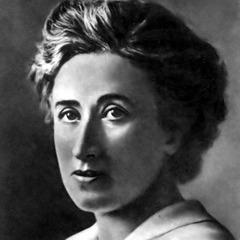
Rosa Luxemburg (March 5, 1871 – January 15, 1919) was a Polish-German Marxist philosopher, economist, and revolutionary. She was a key figure in the German Social Democratic Party and a co-founder of the Communist Party of Germany. Known for her critique of capitalism, theory of imperialism, and advocacy for socialist democracy, she opposed World War I and was imprisoned for her anti-war activities. Luxemburg was murdered by right-wing paramilitaries during the German Revolution of 1919. Her works, including 'The Accumulation of Capital' and 'The Russian Revolution,' remain influential in Marxist theory. more

You May Also Like

“At the present time, it is of course still impossible to foresee to any precise degree just what sections of the field of history will be illuminated and just how much light will be cast by a materialist investigation which would proceed from a more concrete study of the capitalist curve and the interrelationship between the latter and all the aspects of social life. Conquests that may be attained on this road can be determined only as the result of such an investigation itself, which must be more systematic, more orderly than those historical materialist excursions hitherto undertaken. In any case, such an approach to modern history promises to enrich the theory of historical materialism with conquests far more precious than the extremely dubious speculative juggling with the concepts and terms of the materialist method that has, under the pens of some of our Marxists, transplanted the methods of formalism into the domain of the materialist dialectic, and has led to reducing the task to rendering definitions and classifications more precise and to splitting empty abstractions into four equally empty parts; it has, in short, adulterated Marxism by means of the indecently elegant mannerisms of Kantian epigones. It is a silly thing indeed endlessly to sharpen and resharpen an instrument to chip away Marxist steel, when the task is to apply the instrument in working over the raw material!”

“Politics always lags behind economics, far behind. The state apparatus is far more resistant than is possible to believe; and it succeeds, at moments of crisis, in organizing greater forces loyal to the regime than the depth of the crisis might lead one to suppose. This is especially true of the more important capitalist states.”

“Your future should be more than just proving others wrong. Your why and your lighthouse must be specific to you and developed from your life, your situation, your deep-rooted hunger, your past, your pain, your fears, and who you are built to be.”

“The law of combined development of backward countries – in the sense of a peculiar mixture of backward elements with the most modern factors – here rises before us in its most finished form, and offers a key to the fundamental riddle of the Russian revolution. If the agrarian problem, as a heritage from the barbarism of the old Russian history, had been solved by the bourgeoisie, if it could have been solved by them, the Russian proletariat could not possibly have come to power in 1917. In order to realise the Soviet state, there was required a drawing together and mutual penetration of two factors belonging to completely different historic species: a peasant war – that is, a movement characteristic of the dawn of bourgeois development – and a proletarian insurrection, the movement signalising its decline. That is the essence of 1917.”

“A radical social revolution depends on certain definite historical conditions of economic development as its precondition. It is also only possible where with capitalist production the industrial proletariat occupies at least an important position among the mass of the people. And if it is to have any chance of victory, it must be able to do immediately as much for the peasants as the French bourgeoisie, mutatis mutandis, did in its revolution for the French peasants of that time. A fine idea, that the rule of labour involves the subjugation of land labour! But here Mr Bakunin's innermost thoughts emerge. He understands absolutely nothing about the social revolution, only its political phrases. Its economic conditions do not exist for him. As all hitherto existing economic forms, developed or undeveloped, involve the enslavement of the worker (whether in the form of wage-labourer, peasant etc.), he believes that a radical revolution is possible in all such forms alike. Still more! He wants the European social revolution, premised on the economic basis of capitalist production, to take place at the level of the Russian or Slavic agricultural and pastoral peoples, not to surpass this level [...] The will, and not the economic conditions, is the foundation of his social revolution.”

“Like right, so crime, i.e. the struggle of the isolated individual against the prevailing conditions, is not the result of pure arbitrariness. On the contrary, it depends on the same conditions as that rule. The same visionaries who see in right and law the domination of some independently existing, general will can see in crime the mere violation of right and law.”

“Every ideology dies together with the social relations which produced it. This final disappearance is, however, preceded by a moment when the ideology, suffering the blows of the critique directed at it, loses its ability to veil and conceal the social relations from which it emanated. The exposure of the roots of an ideology is a sure sign of its imminent end. For, as Lassalle said: "The dawning of a new age always consists only in the knowledge attained about the true nature of the preceding reality.”