Quotessence
Home / Quotes / Quote by Euripides

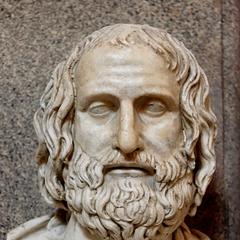
Quote by Euripides

“The men of old times had little sense;/If you called them fools you wouldn't be far wrong./They invented songs, and all the sweetness of music,/To perform at feasts, banquets, and celebrations;/But no one thought of using/Songs and stringed instruments/To banish the bitterness and pain of life.”

Quote by Euripides

Book:Medea

Work

Medea

This book is a renowned work of Greek literature, exploring themes of revenge and betrayal through the character of Medea. more

Author

Euripides
Euripides

Euripides, a renowned Greek tragic playwright, is one of the three great tragic poets of ancient Greece, alongside Aeschylus and Sophocles. His life and achievements are not well-documented. more

You May Also Like

“If Greek culture has influenced Western civilization, we must not forget that, in spite of the inestimable benefits of Greece to India, the ancient Greeks themselves were also sons of Hindu thought. As has already been mentioned, Pythagoras went to India in order to draw from the very source the principles which constituted the foundation of his doctrine and which in its turn influenced Plato, Socrates and even Aristotle to a certain degree. Apollonius of Tyanae, Plotin, did they not follow in the footprints of their predecessors, in directing themselves towards far-off India? China, Persia, Islam – the three-fourths of Asia – these civilizations which had already been influenced by the missions of Asoka, were they not attracted by India’s wisdom? That is the reason why ancient India is our Mother. In the measure that we Westerners make our intellectual and spiritual genealogy reach back to India shall we learn to love her and to consider in its true light her wisdom, the patrimony of every man.”

“The hospital’s long-time cook, Iryna, mechanically peeled potatoes as usual — breakfast had to be prepared for the patients. Work was work, and she was now the only breadwinner in her family. Yet today her thoughts were entirely at home. There, her pregnant daughter Maria had been struck down by typhus and had lain alone in critical condition for a week. To make matters worse, no one was with her. Normally, Iryna would visit her sick daughter during the day. But today the hospital was in emergency mode — another convoy of wounded from the civil war had arrived. A mother’s heart was tearing itself toward her child… though what could she really do? Wiping her hands on a towel, Iryna approached the small icon depicting the Virgin Mary with the infant Jesus. She knelt, folded her hands to her chest, fixed her gaze on the immaculate face of the Mother of God — and began to pray. — Volodymyr Shablia, Stone. Book One Context note: Set during the chaos of the Ukrainian Civil War and a typhus epidemic, this scene shows the quiet suffering of civilians. While the hospital is overwhelmed with wounded, a mother torn between duty and fear turns to faith — highlighting the human cost of war beyond the battlefield.”

“In Dallas for the premier of '9 to 5', I had an uncanny experience, and on the plane home to Chicago I confessed it to Siskel: I had been granted a private half hour with Dolly Parton, and as we spoke I was filled with a strange ethereal grace. This was not spiritual, nor was it sexual. It was healing and comforting. Gene listened and said, "Roger, I felt the exact same thing during my interview with her." We looked at each other. What did this mean? Neither one of us ever felt that feeling again. From time to time we would refer to it in wonder.”