Quotessence
Home / Quotes / Quote by Confucius

Quote by Confucius

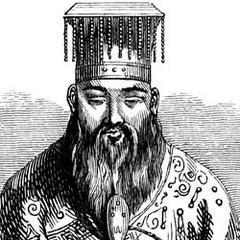
“The noble-minded have nine states of mind: for eyes, bright; for ears, penetrating; for countenance; cordial; for demeanor, humble; for words, trustworthy; for service, reverent; for doubt, questioning; for anger circumspect; and for facing a chance to profit, moral.”

Quote by Confucius

Work

The Analects

The Analects is a foundational text of Confucianism, compiling the sayings and thoughts of the ancient Chinese philosopher Confucius. It covers a range of topics including moral philosophy, governance, and social conduct. more

Author

Confucius
Confucius

Confucius, also known as Kong Qiu or Zhongni, was a great philosopher, educator, and politician during the Spring and Autumn period of ancient China. He advocated for benevolence, rule of propriety, and the doctrine of the mean, and his thoughts have had a profound impact on Chinese and world culture. more

You May Also Like

“Well, Monsieur said Louis XVI good-naturally, are you happy with your King? « Sire, this is the second time that Your Majesty gives me back my life. The first time was by agreeing to endorse the will of my father; this time it's protecting me with this royal generosity. I have always belonged to him, but now, since I will have the honor to be the guardian of his person, I want the King to know that he can demand anything from me, he can expect anything from my devotion, and if a falcon, I shall be that in the future for the King, he can start at any time whatsoever, on any enemy whatsoever, in peace as in war, in the shadow as in the light. « So be it, Monsieur! The King accepts your tribute and will register your promise. You will be a safe weapon in his hand, a weapon he will use, you can be certain, for only the most just causes. You will be in the future the Kings Falcon, but only for three people, me, you and… Monsieur de Rochambeau present here who witnessed your commitment.”

“Before I went to college I read two books. I read a book “Moral Mazes” by Robert Jackall which is a study of how corporations work, and it’s actually a fascinating book, this sociologist, he just picks a corporation at random and just goes and studies the middle managers, not the people who do any of the grunt work and not the big decision makers, just the people whose job is to make sure that things day to day get done, and he shows how even though they’re all perfectly reasonable people, perfectly nice people you’d be happy to meet any of them, all the things that they were accomplishing were just incredibly evil. So you have these people in this average corporation, they were making decisions to blow out their worker’s eardrums in the factory, to poison the lakes and the lagoons nearby, to make these products that are filled with toxic chemicals that poisoned their customers, not because any of them were bad people and wanted to kill their workers and their neighbourhood and their customers, but just because that was the logic of the situation they were in. Another book I read was a book “Understanding Power” by Noam Chomsky which kind of took the same sort of analysis but applied it to wider society which you know we’re in a situation where it may be filled with perfectly good people but they’re in these structures that cause them to continually do evil, to invade countries, to bomb people, to take money from poor people and give it to rich people, to do all these things that are wrong. These books really opened my eyes about just how bad the society we were living in really is.”

“An old, mad, blind, despised, and dying king, - Princes, the dregs of their dull race, who flow Through public scorn, - mud from a muddy spring, - Rulers who neither see, nor feel, nor know, But leech-like to their fainting country cling, Till they drop, blind in blood, without a blow, - A people starved and stabbed in the untilled field, - An army, which liberticide and prey Makes as a two-edged sword to all who would wield, - Golden and sanguine laws which tempt and slay; Religion Christless, Godless - A book sealed; A Senate, - Time's worst statue unrepealed, - Are graves, from which a glorious Phantom may Burst, to illumine our tempestuous day. - Sonnet: England in 1819”

“Seen in this way, it represents a challenge of the grassroots to the elite, of popular to the official, of the weak to the strong... ...More than twenty years have passed since Tiananmen protests of 1989, and from today's perspective their greatest impact has been the lack of progress in reforming the political system. It's fair to say political reform was taking place in the 1980s, even if its pace was slower than that of economic reform. After Tiananmen, however, political reform ground to a halt, while economy began breakneck development. Because of this pradox we find ourselves in a reality full of contradictions: conservative here, radical there; the concentration of political power on this side, the unfettering of economic interests on that; dogmatism on the one hand, anarchism on hte other; toeing the line here, tossing away the rule book there. Over the past twenty years our development has been uneven rather than comprehensive, and this lopsided development is compromising the health of our society. It seems to me that the emergence - and unstoppable momentum - of the copycat phenomenon is an inevitable consequence of this lopsided development. The ubiquity and sharpness of social contradictions have provoked confusion in people's value systems and worldview, thus giving birth to the copycat effect, when all kinds of social emotions accumulate over time and find only limited channels of release, transmuted constantly into seemingly farcical acts of rebellion that have certain anti-authoritarian, anti-mainstream, and anti-monopoly elements. The force and scale of copycatting demonstrate that the whole nation has taken to it as a form of performance art.”

“Studying the world's oldest writing for the first time compels you to wonder about what writing is and how it came about more than five thousand years ago and what the world might have looked like without it. Writing as I would define it serves to record language by means of an agreed set of symbols that enable a message to be played back like a wax cylinder recording. The reader's eye runs over the signs and tells the brain how each is pronounced and the inner message springs into life.”

“The daughter of Sin was determined to go To the dark house, dwelling of Erkalla's god, To the house which those who enter cannot leave, On the road where travelling is one-way only, To the house where those who enter are deprived of light, Where dust is their food, clay their bread. They see no light, they dwell in darkness, They are clothed like birds, with feathers.”